In this guide
- What Is the Deadline to Claim Tax Back in Ireland?
- Which Years Can I Still Claim Tax Back For?
- What Can I Claim Tax Back For?
- How Do I Claim Tax Back on Revenue myAccount?
- Worked Example: How Much Could You Get Back for 2022?
- Do I Need to Pay a Tax Refund Agency?
- What If Revenue Says I Owe Tax Instead?
- Conclusion: Don't Leave Your 2022 Refund Behind
- Frequently Asked Questions
- You can claim tax back from Revenue for the last four years: 2022, 2023, 2024 and 2025
- The 2022 window closes permanently on 31 December 2026. After that, any 2022 refund is gone
- Common refunds come from rent, medical bills, tuition fees, work expenses and unused credits
- PAYE workers claim for free on Revenue myAccount in about 15 minutes per year
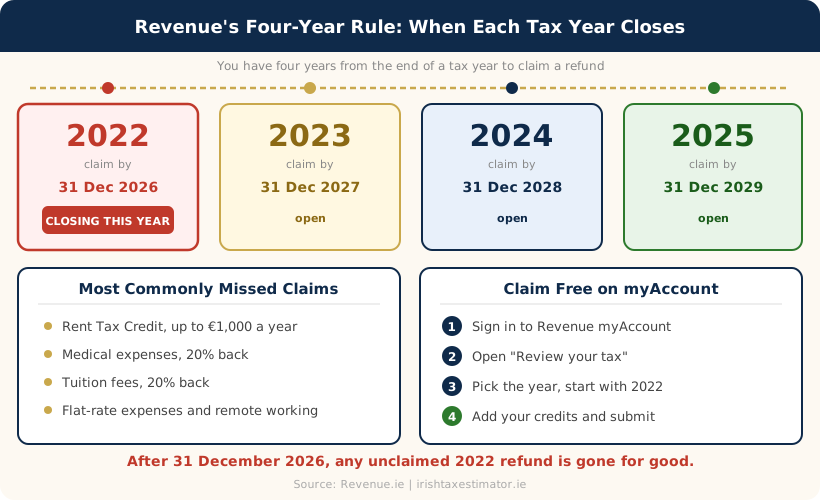
If you have ever paid rent, a doctor's bill or college fees in Ireland, there is a good chance Revenue owes you money. Learning how to claim tax back in Ireland takes about 15 minutes, and it costs nothing. But there is a deadline most people have never heard of. Under Revenue's four-year rule, claims for 2022 must be made by 31 December 2026. Miss it, and that money is lost for good.
This guide explains exactly which years you can still claim, what you can claim for, and the step-by-step process on myAccount. We also walk through a worked example so you can see how quickly small reliefs add up. If you want a quick estimate first, our PAYE tax refund calculator covers 2022 to 2026.
What Is the Deadline to Claim Tax Back in Ireland?
In Ireland, you have four years from the end of a tax year to claim a refund. Claims for 2022 must be made by 31 December 2026. After that date, Revenue cannot repay any 2022 overpayment, and there is no appeal or exception for late claims.
Revenue calls this the four-year rule. In Revenue's own words: "you can only request reviews or claim refunds for the last four years." The rule comes from section 865 of the Taxes Consolidation Act 1997, and Revenue's tax and duty manual on repayments sets out how strictly it applies.
The key point: this is a hard legal limit, not a guideline. It doesn't matter if you forgot, were abroad, or didn't know. Once the date passes, the refund is gone.
Which Years Can I Still Claim Tax Back For?
In 2026, you can claim tax back for 2022, 2023, 2024 and 2025. The 2022 year expires on 31 December 2026, 2023 expires on 31 December 2027, and so on. The oldest year is always the most urgent.
| Tax Year | Last Day to Claim | Status in September 2026 |
|---|---|---|
| 2022 | 31 December 2026 | Closing soon: act now |
| 2023 | 31 December 2027 | Open |
| 2024 | 31 December 2028 | Open |
| 2025 | 31 December 2029 | Open |
| 2026 | 31 December 2030 | Claim from January 2027 |
You can't claim for the current year (2026) as a completed review until it ends. You can, however, add credits for 2026 right now through "Manage your tax 2026" in myAccount, so they reduce your tax on each payslip instead of waiting for a refund.
What Can I Claim Tax Back For?
Most refunds come from reliefs and credits people are entitled to but never claimed. Here are the most common ones for PAYE workers.
| Relief or Credit | What You Get Back | Good to Know |
|---|---|---|
| Rent Tax Credit | €500 for 2022 and 2023, €1,000 for 2024 and 2025 (single) | Double for married couples. See our Rent Tax Credit guide |
| Medical expenses | 20% of what you paid | GP, consultant, prescriptions, some dental. See our medical expenses guide |
| Tuition fees | 20% of qualifying fees | First €3,000 (full-time) or €1,500 (part-time) is disregarded |
| Flat-rate expenses | Relief at your marginal rate on a set amount | Depends on your job, for example nurses, teachers, retail staff |
| Remote working | 30% of heat, electricity and broadband for WFH days | See our remote working relief guide |
| Mortgage interest | Up to €1,250 for 2023 to 2025, €625 for 2026 | Homeowners whose interest rose since 2022. See our mortgage interest tax credit guide |
| Unused credits | Varies | Common if you started a job mid-year or were on emergency tax |
If you were ever put on emergency tax, it's worth checking that year first. Our emergency tax guide explains why it happens and how the overpayment is returned.
How Do I Claim Tax Back on Revenue myAccount?
To claim tax back in Ireland, sign in to Revenue myAccount, open "Review your tax" under PAYE Services, choose the year, complete the Income Tax Return by adding any credits or reliefs, and submit. Revenue then issues a Statement of Liability showing your refund.
Here is the full process for PAYE workers:
- Sign in to Revenue myAccount and complete two-factor authentication. If you don't have an account, registering takes a few minutes with your PPS number.
- Go to PAYE Services and click "Review your tax" for the previous four years.
- Pick the year you want to review (start with 2022, as it's the most urgent) and request your Preliminary End of Year Statement if prompted.
- Complete the Income Tax Return. Revenue pre-fills your pay and tax details. Add any rent, medical, tuition or other claims, then check everything is correct.
- Submit the return. According to Revenue, your Statement of Liability appears in "My Documents" about five days later and shows whether you're due a refund.
Repeat steps 3 to 5 for each year. Refunds are paid directly to the bank account registered on myAccount, so make sure your details are up to date before you start.
Worked Example: How Much Could You Get Back for 2022?
Real numbers make this easier to picture. Here is a typical example of a 2022 claim.
Worked Example: Aoife, single PAYE worker renting in Cork (2022 tax year)
In 2022, Aoife paid rent all year, spent €1,500 on GP visits and prescriptions, and paid €4,500 in full-time college fees for her younger brother. She never claimed any of it.
| Claim | Calculation | Refund |
|---|---|---|
| Rent Tax Credit (2022) | Flat credit for a single renter | €500 |
| Medical expenses | €1,500 × 20% | €300 |
| Tuition fees | (€4,500 − €3,000 disregard) × 20% | €300 |
| Total 2022 refund | €1,100 |
Aoife paid well over €1,100 in income tax in 2022, so she gets the full amount back. If she has similar claims for 2023, 2024 and 2025, her total refund across all four years could easily pass €4,000.
One important rule: a refund can only give back tax you actually paid. If your credits already wiped out your tax bill for a year, extra credits won't create a refund for that year. Our refund calculator checks this for you.
Do I Need to Pay a Tax Refund Agency?
No. Refund agencies are legal and can be convenient, but they do exactly the same myAccount steps described above. Most charge a flat fee or keep a percentage of your refund.
For a straightforward PAYE claim, doing it yourself is free and usually faster. An agency or a tax advisor makes more sense if you have several income sources, foreign income, or you're self-employed and file a Form 11. If that's you, our Form 11 guide covers the self-assessment side.
What If Revenue Says I Owe Tax Instead?
Sometimes a review shows an underpayment rather than a refund. This can happen if you had two jobs at once, or received taxable benefits that weren't fully taxed.
It's less scary than it sounds. According to Revenue, you can pay the balance through myAccount, or Revenue will collect it interest free by reducing your tax credits over up to four years. It's always better to know your position than to guess.
Conclusion: Don't Leave Your 2022 Refund Behind
The four-year rule is simple but unforgiving. Here's what to remember:
- 2022 refunds expire on 31 December 2026, and there are no exceptions
- Rent, medical bills, tuition fees and work expenses are the most commonly missed claims
- Claiming yourself on myAccount is free and takes about 15 minutes per year
Put 30 minutes in your diary this week. Start with 2022, then work forward. Not sure if it's worth it? Run your numbers through our free PAYE tax refund calculator and see what Revenue may owe you.
Frequently Asked Questions
What is the deadline to claim tax back for 2022 in Ireland? The deadline is 31 December 2026. Revenue's four-year rule means claims for 2022 must be made by that date. Claims made after it cannot be repaid, whatever the reason for the delay.
How many years can I claim tax back in Ireland? You can claim tax back for the last four tax years. In 2026 that means 2022, 2023, 2024 and 2025. Each year drops out of reach on 31 December four years after it ends.
Can I get a tax refund if I did not pay any tax? No. A tax refund can only give back income tax or USC (Universal Social Charge) you actually paid in that year. If your credits already cover all your tax, claiming extra credits will not produce a refund for that year.
Do I need to pay an agency to claim my tax back? No. PAYE workers can claim directly and for free through Revenue myAccount. Refund agencies do the same steps for you but usually keep a fee or a percentage of your refund.
What happens if Revenue says I owe tax instead? If your review shows an underpayment, Revenue says you can pay it through myAccount, or it will collect the balance interest free by reducing your tax credits over up to four years.
This article is for informational and estimation purposes only. It does not constitute professional tax advice. Tax rules can change. Always check Revenue.ie for the latest figures or consult a qualified tax advisor for your specific situation.
Written and reviewed by an Associate Chartered Accountant (ACA) in Ireland with expertise in Irish personal taxation, payroll deductions, and Revenue.ie guidelines.
Share this guide
Was this guide helpful?