In this guide
- What Is the Mortgage Interest Tax Credit?
- Who Qualifies for the Mortgage Interest Tax Credit?
- How Much Can You Claim for Each Year?
- Worked Example: How the 2026 Credit Is Calculated
- How Do You Claim the Mortgage Interest Tax Credit?
- Don't Forget the Four-Year Deadline
- What Happens After 2026?
- Conclusion: Claim It Before It's Gone
- Frequently Asked Questions
- 2026 is the final year of Ireland's Mortgage Interest Tax Credit
- The maximum has been halved to €625 per property for 2026, down from €1,250
- You need a mortgage balance of €80,000 to €500,000 on 31 December 2022, on your own home
- You can still claim 2023, 2024 and 2025, each worth up to €1,250, if you never did
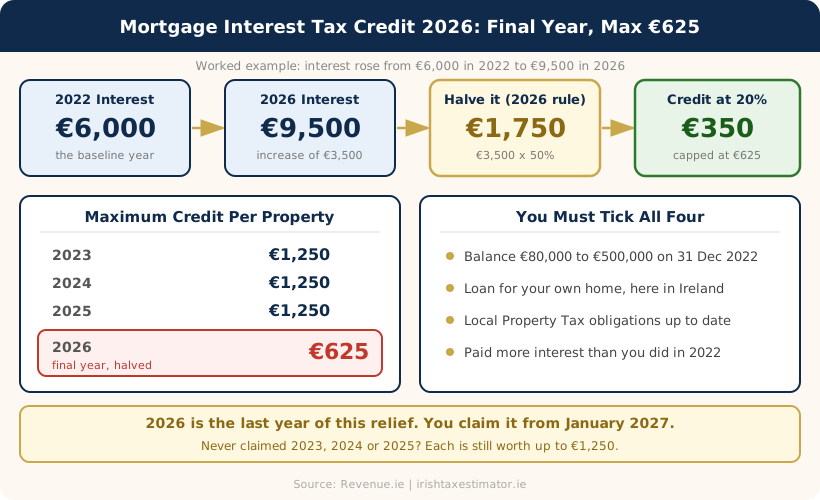
If your mortgage repayments jumped after the interest rate rises of 2022 and 2023, there's a tax credit designed to soften the blow. The catch is that the Mortgage Interest Tax Credit is winding down, and 2026 is the last year it's available. The maximum for 2026 is also half what it was, at €625 per property.
This guide covers who qualifies, how the 2026 calculation differs from earlier years, what documents your lender needs to give you, and how to claim. If you never claimed for 2023, 2024 or 2025, those years are still open and worth up to €1,250 each. Our tax refund calculator can help you see the wider picture of what Revenue may owe you.
What Is the Mortgage Interest Tax Credit?
The Mortgage Interest Tax Credit is a temporary Irish tax credit for homeowners whose mortgage interest rose after 2022. It's worth 20% of the increase in interest you paid compared with 2022, capped at €1,250 for 2023 to 2025 and €625 for 2026.
The credit was introduced by Finance Act 2023 as a response to the sharp rise in interest rates. It was originally a one-year measure for 2023, then extended for 2024, and Finance Act 2025 extended it again to cover 2025 and 2026 on a reduced, tapered basis.
It's a tax credit, not a cash grant. It reduces the income tax you owe. It doesn't reduce USC (Universal Social Charge) or PRSI (Pay Related Social Insurance), and you can't get back more than you actually paid in income tax that year.
Who Qualifies for the Mortgage Interest Tax Credit?
To qualify, you must have had an outstanding mortgage balance between €80,000 and €500,000 on 31 December 2022, on a loan used for your principal private residence in Ireland. You must be compliant with Local Property Tax, and have paid more interest in the claim year than you did in 2022.
Working through the conditions one by one:
- Balance on 31 December 2022 between €80,000 and €500,000. This date is fixed. It doesn't matter what your balance is today.
- The property is in Ireland and is your principal private residence. Revenue also allows the property to be the primary residence of your former or separated spouse, or of a dependent relative.
- The loan is from a qualifying lender listed as a credit information provider by the Central Bank of Ireland, and was used to buy, repair or develop the property.
- You paid interest in both 2022 and the claim year, and the claim-year interest is higher than 2022.
- Your Local Property Tax obligations are met for that property.
This is a homeowner relief. If you're a landlord, mortgage interest works completely differently: it's an allowable expense against rental profit, not a credit. Our rental income tax guide covers that.
How Much Can You Claim for Each Year?
The formula changed for 2026. For 2023 to 2025 the credit is 20% of the full increase over 2022. For 2026, only half of the increase counts.
| Tax Year | What Counts | Rate | Maximum Credit |
|---|---|---|---|
| 2023 | Full increase over 2022 | 20% | €1,250 |
| 2024 | Full increase over 2022 | 20% | €1,250 |
| 2025 | Full increase over 2022 | 20% | €1,250 |
| 2026 | 50% of the increase over 2022 | 20% | €625 |
In practical terms, the 2026 credit is worth about 10% of your actual interest increase, because the increase is halved before the 20% rate is applied. As Revenue sets out, a €4,000 increase that produced an €800 credit in 2025 produces only €400 in 2026.
Worked Example: How the 2026 Credit Is Calculated
Worked Example: Niamh and Dara, joint mortgage on their home in Galway
They paid €6,000 in mortgage interest in 2022. Rate rises pushed their interest higher in the years since. Their balance on 31 December 2022 was €240,000, which is inside the qualifying range.
| Year | Interest Paid | Increase Over 2022 | Amount That Counts | Credit |
|---|---|---|---|---|
| 2025 | €10,000 | €4,000 | €4,000 | €800 |
| 2026 | €9,500 | €3,500 | €1,750 (50% taper) | €350 |
For 2026, the €3,500 increase is halved to €1,750, then taxed at 20%, giving €350. Had 2026 used the old rules, the same interest would have produced a €700 credit.
Note that their interest fell slightly between 2025 and 2026, but they still qualify. What matters is the comparison against 2022, not against last year.
How Do You Claim the Mortgage Interest Tax Credit?
To claim, request a certificate of mortgage interest from your lender plus confirmation of your 31 December 2022 balance, sign in to Revenue myAccount, file an income tax return for the year, and add the Mortgage Interest Tax Credit, uploading the documents.
The steps in full:
- Ask your lender for two documents: confirmation of your mortgage balance as at 31 December 2022, and a certificate of mortgage interest for 2022 and for each year you're claiming. Most lenders provide these through online banking.
- Sign in to Revenue myAccount and open "Review your tax" for the relevant year.
- Complete the Income Tax Return for that year. You have to file a return to get this credit, even if you'd otherwise have no reason to file one.
- Add the Mortgage Interest Tax Credit on the tax credits page and upload your documents.
You can't claim the 2026 credit until the year has ended, so that claim opens in January 2027. Claims for 2023, 2024 and 2025 can be made right now.
Don't Forget the Four-Year Deadline
The Mortgage Interest Tax Credit follows Revenue's ordinary time limit for claims. You have four years from the end of a tax year, so a 2023 claim must be in by 31 December 2027.
If you're logging in to claim this anyway, it's worth reviewing the same years for everything else you may have missed. Rent, medical expenses and tuition fees are the most commonly overlooked. Our guide to claiming tax back in Ireland walks through the process, and note that the 2022 year closes on 31 December 2026.
What Happens After 2026?
No extension beyond 2026 has been legislated. Unless a future Budget revives it, the relief ends with the 2026 tax year, and the final claims will be made during 2027.
That makes the next 18 months the window to collect everything you're entitled to across 2023 to 2026. For homeowners who bought recently, it's also worth checking whether you qualified for Help to Buy, which is a separate and much larger relief for first-time buyers.
Conclusion: Claim It Before It's Gone
Three things to take away:
- 2026 is the final year, and the maximum is now €625 rather than €1,250
- The €80,000 to €500,000 balance test is measured on 31 December 2022, not today
- 2023, 2024 and 2025 are still claimable, at up to €1,250 each, if you never got around to it
Get your certificates of interest from your lender, then set aside 20 minutes on myAccount. While you're there, check what else you're owed with our free tax refund calculator.
Frequently Asked Questions
How much is the Mortgage Interest Tax Credit in 2026? The maximum is €625 per property in 2026, down from €1,250 in 2023, 2024 and 2025. For 2026 the credit is 20% of 50% of the increase in your mortgage interest compared with 2022, as set out by Revenue.
Who qualifies for the Mortgage Interest Tax Credit? You need an outstanding mortgage balance between €80,000 and €500,000 on 31 December 2022, on a qualifying loan for your principal private residence in Ireland. You must also be compliant with Local Property Tax and have paid more interest in the claim year than in 2022.
Is 2026 the last year of mortgage interest relief in Ireland? Yes. Finance Act 2023 introduced the credit for 2023, and Finance Act 2025 extended it to cover 2025 and 2026 on a tapered basis. No further extension has been legislated, so 2026 is currently the final year.
What documents do I need to claim mortgage interest relief? You need confirmation of your mortgage balance as at 31 December 2022 and a certificate of mortgage interest for 2022 and for each year you are claiming. Your lender issues both. You upload them through Revenue's online services.
Can I still claim mortgage interest relief for 2023? Yes. Under Revenue's four-year rule, a 2023 claim can be made up to 31 December 2027. You must file an income tax return for each year you are claiming, even if you have no other reason to file one.
This article is for informational and estimation purposes only. It does not constitute professional tax advice. Tax rules can change. Always check Revenue.ie for the latest figures or consult a qualified tax advisor for your specific situation.
Written and reviewed by an Associate Chartered Accountant (ACA) in Ireland with expertise in Irish personal taxation, payroll deductions, and Revenue.ie guidelines.
Share this guide
Was this guide helpful?