In this guide
- Why Was I Put on Emergency Tax?
- Emergency Tax Rates in Ireland (2026 Rules)
- 1. Emergency Tax Scale (With PPSN Supplied)
- 2. Emergency Tax Scale (Without PPSN Supplied)
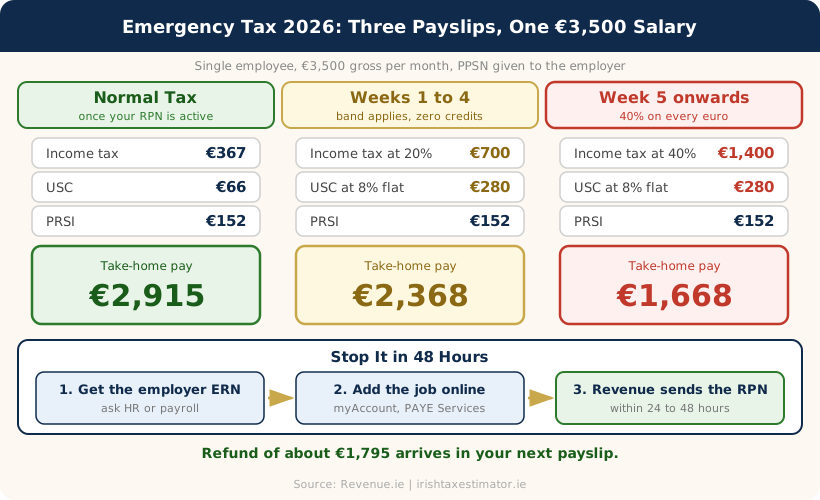
- Worked Example: Emergency Tax on a €3,500/Month Paycheck
- Month 1 (Phase 1 — Weeks 1 to 4):
- Month 2 (Phase 2 — Week 5 onwards):
- Total Emergency Tax Overpaid Across 2 Months:
- How to Stop Emergency Tax in 3 Steps (And Get Your Refund)
- Step 1: Get Your Employer Registered Number (ERN)
- Step 2: Register the Job on Revenue myAccount
- Step 3: Automatic Refund on Your Next Payslip
- What If You Leave a Job While on Emergency Tax?
- Frequently Asked Questions
- Can my employer refund emergency tax before Revenue sends the RPN?
- Will I be taxed on emergency basis if I have two jobs?
- Summary Checklist
- Emergency tax occurs when you start a new job in Ireland before Revenue issues a Revenue Payroll Notification (RPN) to your employer
- If you gave your PPSN, you get the standard band (€846.15/wk) for Weeks 1 to 4 with zero tax credits; from Week 5 onwards, 100% of your income is taxed at 40% plus 8% USC
- If no PPSN was provided, you are taxed at 40% higher rate from Week 1
- You get 100% of your overpaid tax back automatically in your next payslip once you register the job on Revenue myAccount
- Calculate your expected refund with our free Emergency Tax Calculator
Starting a new job in Dublin, Cork, Galway, or anywhere across Ireland is exciting — until you open your very first paycheck and discover that nearly half your wages have been stripped away by tax deductions.
This is Emergency Tax (formally known as emergency basis deduction), and it is one of the most common payroll surprises for employees in Ireland, especially graduates, professionals changing employers, and expats relocating to the country.
The good news is that emergency tax is completely temporary. In this comprehensive guide, we explain how the Irish Revenue Commissioners (Revenue.ie) calculate emergency tax in 2026, the exact rules for Weeks 1 to 4 versus Week 5+, and the exact 3-step process to claim your full refund within 48 hours.
Why Was I Put on Emergency Tax?
By Irish law, employers are strictly prohibited from guessing an employee's tax rate, tax credits, or marital status.
When you start working for an Irish employer, they must request an electronic Revenue Payroll Notification (RPN) from Revenue. The RPN instructs your employer exactly how much tax credit (€) and standard rate cut-off (€) to apply each pay period.
You are placed on emergency tax if:
- You have not registered your new employment on Revenue myAccount.
- Your employer has not yet received an active RPN before running payroll.
- You have not provided a valid Personal Public Service Number (PPSN) to your employer.
- This is your first job in Ireland and your PPSN has not yet been linked to Irish tax records.
Emergency Tax Rates in Ireland (2026 Rules)
Revenue applies two different emergency tax scales depending on whether you provided your PPSN to your employer.
1. Emergency Tax Scale (With PPSN Supplied)
If your employer has your valid PPSN on file:
| Time on Emergency Tax | Income Tax (PAYE) Rate | Standard Band Allowance | Tax Credits Applied | USC Rate |
|---|---|---|---|---|
| Weeks 1 to 4 (or Month 1) | 20% up to cut-off 40% on balance | €846.15 / week (€44,000 / 52) | €0.00 (Zero credits) | 8.0% flat on all income |
| Week 5 onwards (or Month 2+) | 40% flat on 100% of income | €0.00 (No band) | €0.00 (Zero credits) | 8.0% flat on all income |
In Weeks 1 to 4, you receive the standard 20% rate band, but because zero tax credits are granted (you lose your standard €2,000 Single Credit and €2,000 PAYE Credit), you pay significantly more tax.
From Week 5 onwards, the standard band is completely removed: 100% of your earnings are taxed at 40% income tax plus 8% USC plus 4.35% Class A PRSI, resulting in a staggering 52.35% total deduction.
2. Emergency Tax Scale (Without PPSN Supplied)
If you have not provided a valid PPSN to your employer, Revenue rules require the highest punitive rate immediately:
- 40% Income Tax on 100% of gross earnings from Week 1.
- 8% Emergency USC on 100% of gross earnings from Week 1.
- 4.35% PRSI (Class A).
- Zero tax credits and zero standard rate band.
Worked Example: Emergency Tax on a €3,500/Month Paycheck
Let's look at Liam, who starts a new marketing role earning €3,500 gross per month (€42,000 per year) and is placed on emergency tax for his first two months because his job wasn't registered in time.
Monthly Gross Pay: €3,500.00 (Single worker with PPSN provided)
Month 1 (Phase 1 — Weeks 1 to 4):
- Standard Band applied: €3,666.67 / month at 20% = €700.00 Income Tax (since €3,500 is within standard band).
- Tax Credits: €0.00 (Standard credits of €333.33/mo not applied).
- Emergency USC: €3,500 × 8% = €280.00
- PRSI (Class A): €3,500 × 4.35% = €152.25
- Total Deductions in Month 1: €1,132.25
- Month 1 Take-Home Pay: €2,367.75 (Normal pay should be ~€2,915)
Month 2 (Phase 2 — Week 5 onwards):
- Income Tax (40% higher rate on all earnings): €3,500 × 40% = €1,400.00
- Emergency USC (8% flat): €3,500 × 8% = €280.00
- PRSI (Class A): €3,500 × 4.35% = €152.25
- Total Deductions in Month 2: €1,832.25 (52.35%)
- Month 2 Take-Home Pay: €1,667.75 (Liam loses over €1,245 compared to normal take-home!)
Total Emergency Tax Overpaid Across 2 Months:
- Total Emergency Tax Paid: €2,964.50
- Normal Cumulative Deductions for 2 Months: €1,169.97
- Total Refund Due to Liam: +€1,794.53
Note that PRSI is the same 4.35% on emergency basis as it is normally (the rate rose from 4.20% on 1 October 2026), so the refund is made up entirely of overpaid income tax and USC.
You can simulate your exact loss and refund amount with our Emergency Tax Calculator.
How to Stop Emergency Tax in 3 Steps (And Get Your Refund)
You do not need to call Revenue or fill out paper forms. The entire process is handled digitally via Revenue myAccount:
Step 1: Get Your Employer Registered Number (ERN)
Ask your company HR, payroll team, or recruitment agency for their Employer Registered Number (ERN). This is a 7 or 8-character registration code (e.g. 1234567T).
Step 2: Register the Job on Revenue myAccount
- Go to Revenue.ie and log into myAccount.
- Click on PAYE Services → Manage Your Tax 2026.
- Click Add Job or Pension.
- Enter your employer's ERN, your official start date, and your estimated salary.
- Allocate your tax credits (€2,000 Personal Credit + €2,000 PAYE Credit) to this job.
- Submit the request.
Step 3: Automatic Refund on Your Next Payslip
Once submitted, Revenue generates a new Revenue Payroll Notification (RPN) on a cumulative basis and transmits it directly to your employer's payroll software within 24 to 48 hours.
When payroll runs your next payslip:
- Your standard tax credits and 20% standard cut-off are applied retroactively from your start date.
- All overpaid Income Tax and USC from prior emergency weeks is automatically credited directly into your net pay.
You do not need to request the refund; it appears as a positive adjustment on your next payslip!
What If You Leave a Job While on Emergency Tax?
If you leave your employment before the emergency tax issue is resolved:
- Ensure your employer submits your leaving date to Revenue.
- At the end of the tax year, log into Revenue myAccount and complete an End of Year Statement (Statement of Liability) for 2026.
- Revenue will balance your entire annual earnings and transfer the overpaid tax directly into your bank account via SEPA transfer within 3 to 5 working days.
For more details on claiming past-year tax refunds, see our PAYE Tax Refund Calculator.
Frequently Asked Questions
Can my employer refund emergency tax before Revenue sends the RPN?
No. Employers are legally bound to follow the active RPN on Revenue's system. They cannot issue a refund until Revenue updates their payroll record.
Will I be taxed on emergency basis if I have two jobs?
If you take a second job (or side gig), your primary tax credits are usually assigned to your main employer. If you do not split your tax credits between the two employers on Revenue myAccount, your second job may be taxed at 40% on all earnings. Read our Side Hustle & Gig Economy Tax Guide for instructions on splitting credits.
Summary Checklist
- Provide your PPSN to your employer on Day 1.
- Register the employment on Revenue myAccount under PAYE Services → Add Job.
- Use our Emergency Tax Calculator to see exactly how much refund to expect on your next payslip.
This article is for informational and estimation purposes only. It does not constitute professional tax advice. Tax rules can change. Always check Revenue.ie for the latest figures or consult a qualified tax advisor for your specific situation.
Written and reviewed by an Associate Chartered Accountant (ACA) in Ireland with expertise in Irish personal taxation, payroll deductions, and Revenue.ie guidelines.
Share this guide
Was this guide helpful?