In this guide
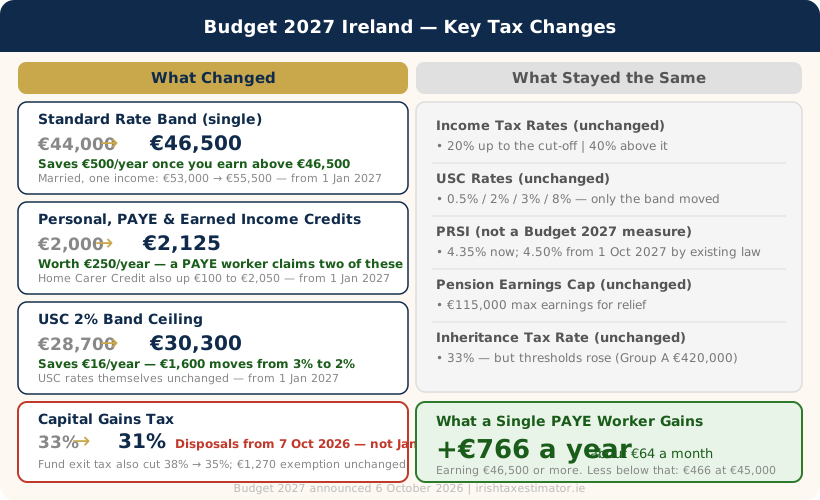
- The standard rate band rises €2,500 to €46,500 for a single person (€55,500 for a married couple with one income)
- The Personal, PAYE and Earned Income credits each rise €125 to €2,125; the Home Carer credit rises €100 to €2,050
- The USC 2% band ceiling rises to €30,300; USC rates themselves are unchanged
- Capital Gains Tax is cut from 33% to 31%, and this one applies from 7 October 2026, not January
- A single worker earning above €46,500 gains €766 a year, around €64 a month
- PRSI was untouched by the Budget, but still rises to 4.50% on 1 October 2027 under existing law
Budget 2027 was delivered to the Dáil on Tuesday, 6 October 2026 by Tánaiste and Minister for Finance Simon Harris, alongside Minister for Public Expenditure Jack Chambers. The personal tax package came in at roughly €1.3 billion within a total budget of €8.5 billion.
The shape of it is straightforward: widen the band so less income is caught at 40%, and lift the credits so everyone gets something. There is no change to the 20% and 40% rates themselves, and no change to USC rates. Below is every confirmed measure, what it is worth, and when it starts.
⚠ Note
These are the measures as announced in the Budget speech. They become law only when the Finance Bill passes later in the year, and figures can move in between. Always check Revenue.ie before relying on a number for a filing.
What You Actually Gain
The band widening is worth a fixed €500 once your income exceeds the new cut-off (€2,500 moved from the 40% rate to the 20% rate). The credit increases add €250 (€125 on the Personal credit plus €125 on the PAYE or Earned Income credit). The USC change adds €16. That caps the gain at €766 a year for most workers.
| Gross Salary | 2026 Net | 2027 Net | Annual Gain | Per Month |
|---|---|---|---|---|
| €30,000 | €26,262 | €26,525 | €263 | €22 |
| €35,000 | €29,895 | €30,161 | €266 | €22 |
| €45,000 | €36,960 | €37,426 | €466 | €39 |
| €55,000 | €42,225 | €42,991 | €766 | €64 |
| €70,000 | €50,122 | €50,888 | €766 | €64 |
| €90,000 | €59,654 | €60,420 | €766 | €64 |
Single PAYE employee, no pension contribution, PRSI at 4.35%. Run your own figure through our 2026 vs 2027 comparison tool.
Two things worth noting in that table. Below about €46,500 you do not get the full band benefit, because only the portion of your income that was being taxed at 40% moves down to 20%. And above €46,500 everyone gains the same €766 regardless of salary, because the band widening is a fixed amount of income rather than a percentage.
ℹ Info
The PRSI rise claws some of this back. PRSI goes from 4.35% to 4.50% on 1 October 2027 under the existing roadmap, which Budget 2027 did not change. Across the whole of 2027 that costs a worker on €55,000 about €21, trimming the real annual gain from €766 to roughly €745. The figures above show the position from January, which is what your first 2027 payslip will look like.
Income Tax: The Standard Rate Band
The standard rate cut-off point rises from €44,000 to €46,500 for a single person, and from €53,000 to €55,500 for a married couple or civil partners with one income. The 20% and 40% rates are unchanged. Effective 1 January 2027.
The standard rate cut-off point is the income threshold above which you pay 40% income tax instead of 20%. Raising it is the single most expensive measure in the package — each €1,000 of band widening costs the Exchequer roughly €230 million, so this €2,500 increase accounts for a large share of the €1.3 billion.
| Status | Single | Married, One Income |
|---|---|---|
| 2026 | €44,000 | €53,000 |
| 2027 | €46,500 | €55,500 |
For a worker on €50,000, this means €2,500 of income that was taxed at 40% in 2026 is taxed at 20% in 2027 — a saving of €500. For a detailed walkthrough of how the bands interact with credits, see our guide on how income tax is calculated in Ireland.
Income Tax: Tax Credits
Credits reduce your income tax bill euro for euro, so a €125 increase is worth exactly €125 to anyone who pays at least that much income tax. They had been frozen since Budget 2025.
| Credit | 2026 | 2027 | Change |
|---|---|---|---|
| Personal Tax Credit (single) | €2,000 | €2,125 | +€125 |
| Personal Tax Credit (married) | €4,000 | €4,250 | +€250 |
| PAYE Tax Credit | €2,000 | €2,125 | +€125 |
| Earned Income Credit (self-employed) | €2,000 | €2,125 | +€125 |
| Home Carer Credit | €1,950 | €2,050 | +€100 |
| Rent Tax Credit (single) | €1,000 | €1,150 | +€150 |
| Rent Tax Credit (couple) | €2,000 | €2,300 | +€300 |
A single PAYE employee claims both the Personal credit and the PAYE credit, so the combined increase is €250. A self-employed person claims the Personal credit and the Earned Income credit, for the same €250.
One important limit: credits can only reduce your tax bill to zero, not below it. If you earn too little to pay €2,125 of income tax in the first place, you cannot use the full credit, and the increase is worth less to you than to a higher earner. If you are not sure you are claiming everything, check our guide to tax credits for PAYE workers.
USC: The 2% Band Widens
USC rates are unchanged. What moved is the ceiling of the 2% band, which rises from €28,700 to €30,300.
| Band | 2026 | 2027 | Rate |
|---|---|---|---|
| First €12,012 | €0 – €12,012 | €0 – €12,012 | 0.5% |
| Second band | €12,013 – €28,700 | €12,013 – €30,300 | 2% |
| Third band | €28,701 – €70,044 | €30,301 – €70,044 | 3% |
| Top band | Above €70,044 | Above €70,044 | 8% |
The effect is that €1,600 of income shifts from the 3% rate to the 2% rate, saving €16 a year for anyone earning above €30,300. It is a small number, but it is the second year running that this ceiling has been lifted — Budget 2026 moved it from €27,382 to €28,700 — and the pattern is clearly to keep it just ahead of the minimum wage, which itself rises 79 cent in 2027.
The USC exemption threshold for total income of €13,000 or less is unchanged. Use our USC calculator for your own breakdown.
Capital Gains Tax: Cut to 31%, Effective Immediately
This is the measure most likely to catch people out, because it does not wait for January.
The standard rate of Capital Gains Tax is cut from 33% to 31% for disposals made on or after 7 October 2026. Disposals up to and including 6 October 2026 remain chargeable at 33%. The €1,270 annual exemption is unchanged.
Because the change is mid-year, a 2026 CGT return can contain gains at both rates depending on when each disposal happened. If you sold shares in March and property in November, those two gains are charged differently.
On a taxable gain of €14,330, the bill falls from €4,729 at 33% to €4,442 at 31% — a saving of €287. Our Capital Gains Tax calculator now applies the 31% rate.
The exit tax on Irish-domiciled funds and offshore funds was also cut, from 38% to 35%. Budget 2026 had already brought it down from 41%, so it has fallen six percentage points in two years.
Alongside this, the Budget announced a new Irish Investment Account, opening on 1 July 2027. Contributions are capped at €12,000 a year with a €50,000 lifetime tax-free threshold, and the account sits outside the CGT, dividend withholding tax and exit tax regimes, with no deemed disposal rule.
PRSI: Unchanged by the Budget
PRSI changes are legislated separately under a multi-year roadmap and did not form part of Budget 2027. They happen regardless.
| Period | Class A Employee Rate | Status |
|---|---|---|
| 1 Jan – 30 Sep 2026 | 4.20% | Superseded |
| 1 Oct 2026 – 30 Sep 2027 | 4.35% | In force |
| From 1 Oct 2027 | 4.50% | Legislated |
| From 1 Oct 2028 | 4.70% | Legislated |
This matters for how you read the headline gain. The €766 figure assumes PRSI at 4.35%, which holds for the first nine months of 2027. From October the rate rises, so the full-year position is slightly worse than the January payslip suggests. Use our PRSI calculator for your exact contribution.
Housing, Inheritance and Family Measures
Help to Buy rises from €30,000 to €35,000. The property price caps are unchanged.
Rent-a-room relief rises from €14,000 to €16,000 of tax-free rental income, and has been extended to cover newly installed detached auxiliary dwellings — relevant if you have a garden room or modular unit let out.
Inheritance tax (CAT) thresholds all rise. The rate stays at 33%.
| Group | Relationship | 2026 | 2027 |
|---|---|---|---|
| A | Child of the disponer | €400,000 | €420,000 |
| B | Sibling, niece, nephew, grandchild | €40,000 | €44,000 |
| C | Everyone else | €20,000 | €22,000 |
Our inheritance tax calculator covers how the thresholds work cumulatively.
Childcare Services Relief, the exemption for self-employed childminders, rises from €15,000 to €20,000. The farm succession partnership tax credit was doubled.
On the indirect side, cigarettes rise €1 a pack and vaping products 20 cent per millilitre. Fuel excise cuts are extended to June 2027, and the scheduled carbon tax rise was paused.
What to Do Now
- Nothing changes on your payslip yet. The income tax, USC and credit changes start on 1 January 2027. Every calculator on this site still shows 2026 rates, which is the correct answer for what is coming out of your pay this month.
- If you are planning an asset disposal, the CGT change is already live. A sale completed on or after 7 October 2026 is charged at 31%. If you were holding off on a disposal, that two-point cut is now banked.
- Check your credits before January. Log into Revenue myAccount and review your Tax Credit Certificate. The increases apply automatically, but credits you have never claimed — such as the Rent Tax Credit or remote working relief — do not.
- If you are in the 40% band, pension contributions still beat the Budget. Relief at your marginal rate is worth more than anything announced here. See our pension tax relief guide.
- Compare your own figures with the 2026 vs 2027 tool or the PAYE calculator.
For more, read our 7 simple tax saving tips for PAYE workers, and our Budget 2026 analysis for how last year's measures compare.
Key Takeaways
- Standard rate band: €44,000 → €46,500 single, €53,000 → €55,500 married one income, from 1 January 2027
- Credits: Personal, PAYE and Earned Income each +€125 to €2,125; Home Carer +€100 to €2,050
- USC: rates unchanged; 2% ceiling €28,700 → €30,300
- CGT: 33% → 31%, for disposals from 7 October 2026 — the one change already in force
- Most workers above €46,500 gain €766 a year, about €64 a month, before the October 2027 PRSI rise trims it slightly
- PRSI was not touched by the Budget but still rises to 4.50% on 1 October 2027
This article is for informational and estimation purposes only. It does not constitute professional tax advice. The measures described were announced on 6 October 2026 and become law when the Finance Bill is passed; details can change. Always check Revenue.ie for the latest figures or consult a qualified tax advisor for your specific situation.
Written and reviewed by an Associate Chartered Accountant (ACA) in Ireland with expertise in Irish personal taxation, payroll deductions, and Revenue.ie guidelines.
Share this guide
Was this guide helpful?