In this guide
- How Does Pension Tax Relief Work in Ireland?
- What Are the Age-Related Pension Contribution Limits?
- What Is the Real After-Tax Cost of a Pension Contribution?
- Why Is the 31 October Pension Deadline Important?
- How Do Additional Voluntary Contributions (AVCs) Work?
- What Happens to Your Pension in Retirement?
- Worked Example: Conor, Age 42, Earning €70,000
- Frequently Asked Questions
- Every €100 you put into a pension costs you only €60 if you are a higher-rate taxpayer, because Revenue refunds the 40% tax
- Age-based contribution limits control how much you can put in each year, between 15% and 40% of earnings, capped at €115,000
- You can make additional voluntary contributions (AVCs) before 31 October to claim relief for the prior tax year
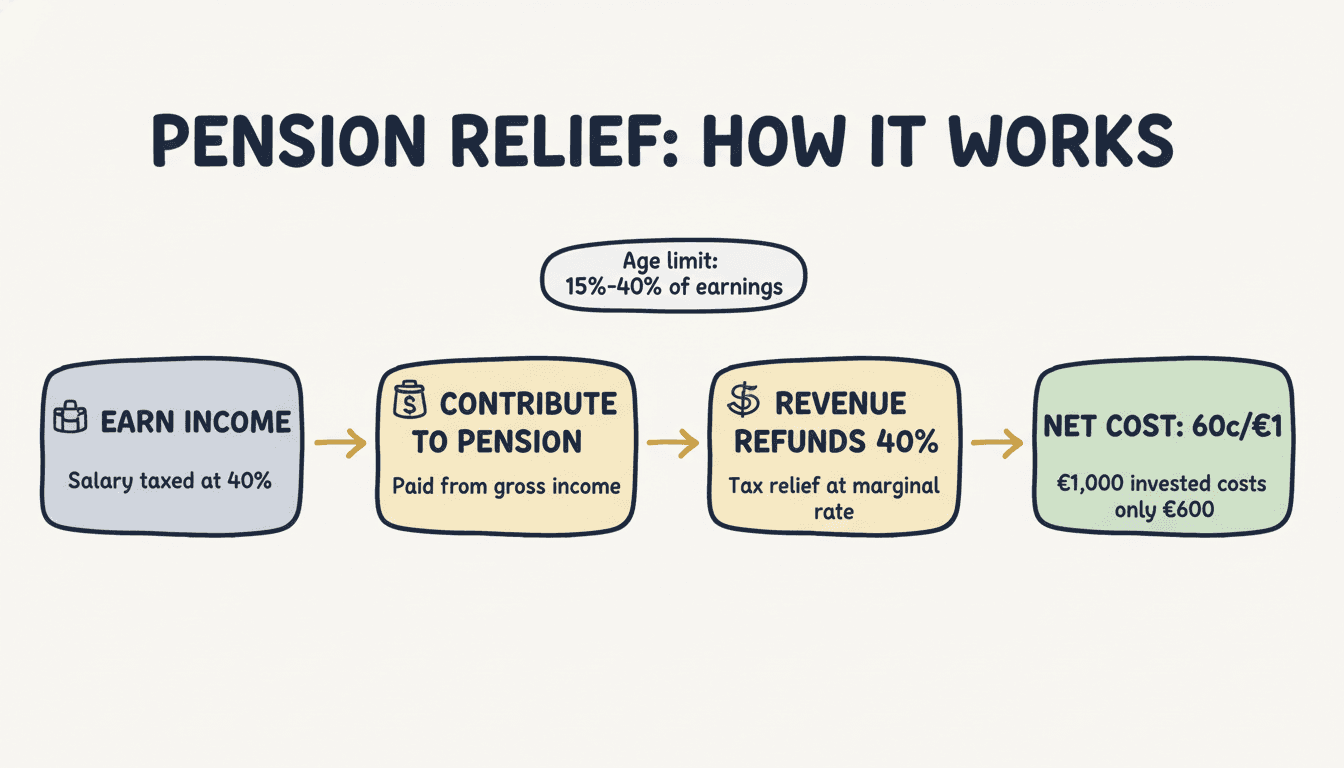
Pension contributions are the most tax-efficient saving vehicle available to Irish workers. Unlike a regular savings account, pension contributions come with an immediate, guaranteed return in the form of tax relief at your marginal rate. For higher-rate taxpayers, every €1 you put in costs you only 60 cent after the tax refund. This guide explains exactly how it works, how much you can contribute, and how to use our Pension AVC Tax Relief Calculator before the key October deadline.
How Does Pension Tax Relief Work in Ireland?
Under Irish tax rules, contributions to an approved pension scheme receive income tax relief at your marginal rate (20% or 40%). A €1,000 contribution costs a higher-rate taxpayer only €600 out of pocket.
According to Revenue.ie, the relief is given at your marginal rate of income tax:
- If you pay income tax at 40% (higher rate), you get 40% relief
- If you pay income tax at 20% (standard rate), you get 20% relief
There is no USC or PRSI relief on employee pension contributions, only income tax relief. But even income tax relief alone makes pensions extremely attractive.
How the relief is received:
- Employer schemes (occupational pensions): Contributions are deducted from your gross pay before tax is calculated. You receive the relief automatically through payroll.
- PRSAs and RACs (personal pensions): You pay the contribution from after-tax income and then claim the relief through Revenue myAccount. Revenue either refunds the tax or adjusts your tax credits.
What Are the Age-Related Pension Contribution Limits?
Revenue sets maximum annual tax-relieved pension contributions as a percentage of your net relevant earnings, capped at a maximum of €115,000 per year. The percentage limit increases with age.
According to the Revenue Commissioners, the statutory age limits under Section 774 of the Taxes Consolidation Act 1997 are:
| Age Bracket | Maximum Annual Contribution (% of Earnings) |
|---|---|
| Under 30 | 15% of net relevant earnings |
| 30 to 39 | 20% |
| 40 to 49 | 25% |
| 50 to 54 | 30% |
| 55 to 59 | 35% |
| 60 and over | 40% |
The absolute maximum earnings on which relief is given is €115,000 per year. For example, the maximum possible tax-relieved contribution for a 60-year-old earning €115,000 or more is 40% × €115,000 = €46,000 per year. You can check your exact limit on our Pension AVC Calculator.
What Is the Real After-Tax Cost of a Pension Contribution?
Because Revenue provides tax relief at your marginal rate, higher-rate taxpayers receive a 40% discount on every euro contributed.
| Gross Contribution | Tax Relief (40% Rate) | Net Out-of-Pocket Cost |
|---|---|---|
| €1,000 | €400 | €600 |
| €5,000 | €2,000 | €3,000 |
| €10,000 | €4,000 | €6,000 |
| €20,000 | €8,000 | €12,000 |
You are essentially getting an immediate 67% return on your money the moment you make the contribution (you invested €600 and your pension fund holds €1,000). The fund then compounds tax-free until retirement.
For standard-rate (20%) taxpayers, every €100 costs €80 after relief, providing an immediate 25% return.
Why Is the 31 October Pension Deadline Important?
Under Section 787 of the Taxes Consolidation Act 1997, you can make a lump-sum pension contribution before 31 October and elect to attribute the tax relief to the prior tax year.
Why does this matter? Many people do not know their exact final tax liability until completing their annual review. You can calculate your previous year tax position, see how much room you have within your age-related limit, and top up your pension before 31 October to claim a direct cash refund from Revenue.
Self-employed individuals and PAYE workers with personal pensions can use this to lower their prior-year tax bill retrospectively.
Key deadlines to remember:
- 31 October: Statutory deadline to contribute and claim relief for the prior tax year
- Mid-November: Extended deadline for self-assessed taxpayers filing and paying electronically via ROS
How Do Additional Voluntary Contributions (AVCs) Work?
AVCs are extra contributions you make above your standard employee pension contribution, up to your statutory age-related limit.
AVCs are one of the most efficient ways to build wealth because:
- The relief is applied directly through payroll under net pay arrangement, so you never pay the tax in the first place
- You do not need to file manual claims with Revenue for payroll-deducted AVCs
- Some employers offer partial matching on AVCs
You can use our Pension AVC Tax Relief Calculator to see your remaining headroom and potential tax savings.
What Happens to Your Pension in Retirement?
On retirement (from age 50 for company schemes, or 60 to 65 typically), you can take up to 25% of your fund as a tax-free lump sum, subject to a lifetime limit of €200,000.
According to Citizens Information, retirement funds are treated as follows:
- The first €200,000 is completely tax-free
- Amounts from €200,001 to €500,000 are taxed at the standard rate of 20%
- Amounts above €500,000 are taxed at your marginal rate plus USC
The remaining 75% of your fund is typically invested in an Approved Retirement Fund (ARF) or used to purchase an annuity.
Worked Example: Conor, Age 42, Earning €70,000
Conor is a PAYE worker earning €70,000 and paying income tax at the 40% marginal rate. He wants to maximise his pension contributions in 2026.
| Step | Calculation | Amount |
|---|---|---|
| Statutory Age Limit (40 to 49) | 25% of €70,000 | €17,500 |
| Employer & Employee Base Contrib | 5% employee contribution | -€3,500 |
| Remaining AVC Headroom | €17,500 - €3,500 | €14,000 |
| Marginal Tax Relief (40%) | 40% of €14,000 | €5,600 |
| Net Out-of-Pocket Cost | €14,000 - €5,600 | €8,400 |
Conor adds €14,000 into his pension pot, but it only costs him €8,400 in net salary. Revenue funds the other €5,600 through tax relief.
Use our Pension AVC Tax Relief Calculator to model your own situation, or check our PAYE Tax Calculator and Auto-Enrolment Pension Calculator to explore other workplace pension options. Thinking of leaving My Future Fund? Read should I opt out of auto-enrolment first.
Frequently Asked Questions
Can I claim pension tax relief if I am on the standard 20% rate? Yes. The relief is given at whatever rate you pay income tax. If all your income falls in the standard rate band, you get 20% relief. It is less dramatic than 40% relief, but still a valuable benefit.
Is there a minimum pension contribution? No minimum is required by Revenue to claim relief, but pension providers may have their own minimums (often €100 to €200 per month or a lump sum minimum).
Can I contribute to a pension and claim it before the year end? Yes. Contributions made before 31 December count for the current year. Contributions made between 1 January and 31 October the following year can be backdated to the prior year if you elect to do so.
What is the maximum tax-free lump sum I can take at retirement? The lifetime limit for tax-free lump sums from all pension sources combined is €200,000. Amounts from €200,001 to €500,000 are taxed at 20%. Amounts above €500,000 are taxed at your marginal income tax rate.
I am self-employed. What pension products are available to me? Self-employed individuals can use a PRSA, a Retirement Annuity Contract (RAC), or, if they operate through a company, an executive pension scheme.
This article is for informational and estimation purposes only. It does not constitute professional tax advice. Tax rules can change. Always check Revenue.ie for the latest figures or consult a qualified tax advisor for your specific situation.
Written and reviewed by an Associate Chartered Accountant (ACA) in Ireland with expertise in Irish personal taxation, payroll deductions, and Revenue.ie guidelines.
Share this guide
Was this guide helpful?