In this guide
- What Is Auto-Enrolment (My Future Fund)?
- How Much Goes Into My Future Fund?
- When Can I Opt Out of Auto-Enrolment?
- What Do I Lose If I Opt Out?
- Worked Example: Opting Out on a €40,000 Salary
- Is Auto-Enrolment Better Than a PRSA?
- When Might Opting Out Make Sense?
- Conclusion: Think Twice Before Opting Out
- Frequently Asked Questions
- My Future Fund launched on 1 January 2026, and over 800,000 workers have been enrolled
- You can opt out during months 7 and 8 of membership. Your own contributions are refunded
- Employer and State contributions already paid stay in your pot, but you lose all future ones
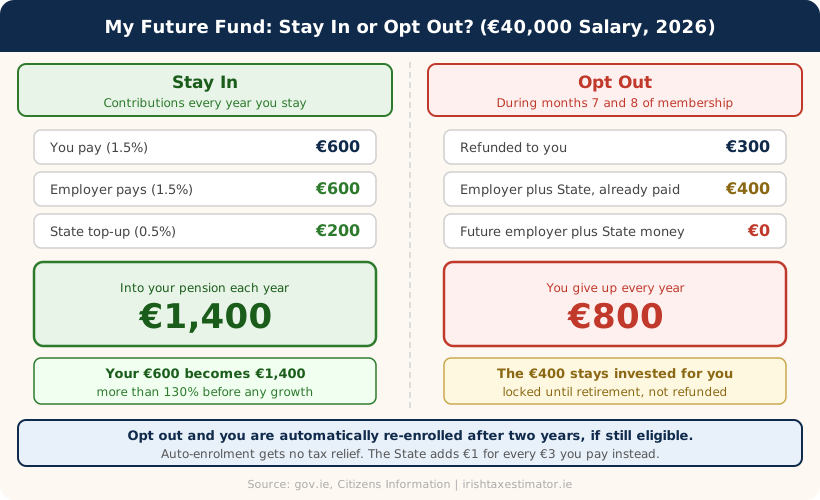
- On a €40,000 salary, staying in turns €600 of your money into €1,400 of pension savings a year
If you started a job in Ireland this year, you've probably noticed a new deduction on your payslip. It's auto-enrolment, the State's new pension scheme called My Future Fund. Now that the first opt-out window is open, many workers are asking one question: should I opt out of auto-enrolment?
According to RTÉ, more than 800,000 workers were enrolled in the first six months of 2026, with over €400 million already saved. The opt-out window opened on 1 July 2026. This guide explains what opting out really costs, what you get back, and when it might make sense. For your personal numbers, try our free auto-enrolment pension calculator.
What Is Auto-Enrolment (My Future Fund)?
Auto-enrolment is Ireland's workplace pension scheme, branded My Future Fund, which began on 1 January 2026. Employees aged 23 to 60 earning over €20,000 who aren't in a payroll pension are enrolled automatically. You, your employer and the State all pay in.
The scheme is run by the National Automatic Enrolment Retirement Savings Authority (NAERSA). It was set up to close Ireland's pension gap, since many private sector workers had no pension other than the State Pension.
You don't need to sign up. If you meet the conditions, your employer enrols you and starts deducting contributions from your gross pay. If you're already in a pension scheme through your employer's payroll, you aren't enrolled.
How Much Goes Into My Future Fund?
In 2026, you pay 1.5% of your gross pay, your employer matches it with 1.5%, and the State adds a top-up of 0.5%. That's €1 from the State for every €3 you pay. Rates rise every three years until they reach 6% each from 2035.
| Phase | Years | You Pay | Employer Pays | State Top-Up | Total |
|---|---|---|---|---|---|
| Phase 1 | 2026 to 2028 | 1.5% | 1.5% | 0.5% | 3.5% |
| Phase 2 | 2029 to 2031 | 3% | 3% | 1% | 7% |
| Phase 3 | 2032 to 2034 | 4.5% | 4.5% | 1.5% | 10.5% |
| Phase 4 | 2035 onwards | 6% | 6% | 2% | 14% |
Contributions are calculated on earnings up to €80,000 a year. The State top-up is always one-third of your own contribution, as confirmed by the Irish Times.
When Can I Opt Out of Auto-Enrolment?
You must stay in My Future Fund for at least six months. You can then opt out during months seven and eight of membership. For workers enrolled in January 2026, the window opened on 1 July 2026. If you opt out, you're re-enrolled after two years if still eligible.
To opt out, you log in to the My Future Fund participant portal using your verified MyGovID and answer some mandatory questions. According to Peninsula Ireland, there's a 48-hour cooling-off period in which you can change your mind.
Your employer can't opt out for you, and they're not allowed to pressure you either way. The choice is yours alone.
What Do I Lose If I Opt Out?
If you opt out, you get your own contributions refunded. Any employer contributions and State top-ups already paid stay invested in your pot until retirement. But you lose all future employer and State contributions, which is the biggest cost of opting out.
This is the part most people miss. A NAERSA spokesperson told RTÉ that by opting out, "employees will forgo contributions from their employer" and the State top-up.
Put simply, your employer's 1.5% is part of your total pay package. If you opt out, your employer doesn't pay it to you as salary instead. It just stops.
Worked Example: Opting Out on a €40,000 Salary
Worked Example: Seán earns €40,000 as a PAYE employee (2026, Phase 1 rates)
| Per Year | First 6 Months | |
|---|---|---|
| Seán pays (1.5%) | €600 | €300 |
| Employer pays (1.5%) | €600 | €300 |
| State top-up (0.5%) | €200 | €100 |
| Total into Seán's pot | €1,400 | €700 |
If Seán opts out in month 7:
- He gets his own €300 refunded
- The €400 from his employer and the State stays in his pot, locked until retirement
- From then on, he gives up €800 a year of free money (employer plus State)
If Seán stays in:
- Every €600 he pays becomes €1,400 in his pension before any investment growth
- That's an instant return of more than 130% on his own money
The €600 costs Seán about €50 a month from his take-home pay. To see how this fits with income tax, USC and PRSI on your salary, use our PAYE tax calculator.
Is Auto-Enrolment Better Than a PRSA?
Auto-enrolment contributions don't get income tax relief. Instead, you get the State top-up. So how does that compare with a traditional pension like a PRSA (Personal Retirement Savings Account)?
For standard-rate (20%) taxpayers, auto-enrolment usually wins. The State top-up of €1 for every €3 you pay works out like 25% relief, which beats 20% tax relief. And you get your employer's contribution on top.
For higher-rate (40%) taxpayers, it's closer. Tax relief on a PRSA is worth 40%, which beats the State top-up. But opting out of auto-enrolment means losing your employer's matching contribution, which is usually worth far more.
Take Seán's €600 again, but assume he pays 40% tax:
| Option | Seán's Cost | Goes Into Pension |
|---|---|---|
| Stay in auto-enrolment | €600 | €1,400 |
| Opt out, pay into a PRSA | €600 | €1,000 (with 40% relief) |
Auto-enrolment still puts €400 more into his pension. Many advisors suggest doing both: stay in auto-enrolment for the employer match, and add a PRSA or AVC for extra tax relief. Our pension tax relief guide and Pension AVC calculator show how much relief you can claim.
When Might Opting Out Make Sense?
Staying in is the better choice for most people. But there are some situations where opting out can be reasonable:
- Real financial hardship. If the deduction means you can't pay rent or essential bills, opting out for now is a reasonable choice. You'll be re-enrolled in two years.
- High-cost debt. Paying off a credit card or moneylender at 20%+ interest can be a better use of cash in the short term.
- A better employer scheme. If your employer offers an occupational pension with a bigger contribution, joining it takes you out of My Future Fund anyway.
As Caroline Rowan of Aon Ireland told RTÉ, the decision "may have a long-term impact on their quality of life in retirement." It's worth taking a few minutes to run the numbers before you decide.
Conclusion: Think Twice Before Opting Out
Here are the key points to remember:
- Opting out refunds your own contributions, but you lose every future euro from your employer and the State
- For most workers, especially 20% taxpayers, staying in is one of the best-value savings options available
- If you opt out, you'll be re-enrolled after two years if you're still eligible
Before you log in to the opt-out portal, see what your pot could look like at retirement. Our free auto-enrolment pension calculator shows your contributions, employer match and State top-up in seconds.
Frequently Asked Questions
When can I opt out of auto-enrolment in Ireland? You must stay in My Future Fund for at least six months. After that, you have a two-month window, during months seven and eight of membership, to opt out. For workers enrolled in January 2026, that window opened on 1 July 2026.
Do I get my money back if I opt out of My Future Fund? You get a refund of your own contributions. Any employer contributions and State top-ups already paid stay invested in your pension pot for retirement. They are not paid back to you or to your employer.
Will I be re-enrolled after opting out? Yes. If you still meet the eligibility rules, you will be automatically re-enrolled after two years. You can then choose to opt out again during the next opt-out window.
Do I get tax relief on auto-enrolment contributions? No. Auto-enrolment contributions do not get income tax relief. Instead, the State adds €1 for every €3 you contribute, which is better value than 20% tax relief for standard-rate taxpayers.
Who is automatically enrolled in My Future Fund? Employees aged 23 to 60 who earn more than €20,000 a year and are not already in a pension scheme through their employer's payroll are automatically enrolled, according to Citizens Information.
This article is for informational and estimation purposes only. It does not constitute professional tax advice. Tax rules can change. Always check Revenue.ie for the latest figures or consult a qualified tax advisor for your specific situation.
Written and reviewed by an Associate Chartered Accountant (ACA) in Ireland with expertise in Irish personal taxation, payroll deductions, and Revenue.ie guidelines.
Share this guide
Was this guide helpful?