In this guide
- What Is the Rent Tax Credit in Ireland?
- Who Qualifies for the Rent Tax Credit in 2026?
- How Much Can You Actually Claim in 2026?
- Can You Claim the Rent Tax Credit if Your Landlord Is Not RTB Registered?
- How to Claim the Rent Tax Credit: Step by Step
- How Much Can You Claim on a 4-Year Backdated Claim?
- Frequently Asked Questions
- Private renters can claim up to €1,000 back from Revenue each year, and €2,000 for jointly assessed couples
- You need to pay at least €5,000 in annual rent to receive the full credit, calculated at 20% of rent paid
- HAP and Housing Association tenants do not qualify, but private renters and student digs do, and you can backdate claims to 2022
If you are renting in Ireland and have not claimed the Rent Tax Credit, you could be leaving up to €1,000 on the table every single year (€2,000 for married couples). The Rent Tax Credit was introduced by Revenue in 2022 and increased to €1,000 per year for single renters in Budget 2025, and that €1,000 amount continues for 2026. Despite this, thousands of eligible PAYE workers still have not made a claim. This guide explains exactly who qualifies, how much you can get, and how to calculate your refund with our Rent Tax Credit Calculator.
What Is the Rent Tax Credit in Ireland?
The Irish Rent Tax Credit provides up to €1,000 per year (€2,000 for jointly assessed couples) for qualifying private residential tenants paying income tax in 2026, claimable directly via Revenue myAccount.
The Rent Tax Credit is a statutory tax relief scheme under Section 473B of the Taxes Consolidation Act 1997 that reduces the amount of income tax you owe to the Revenue Commissioners. For the 2026 tax year, the credit is worth up to €1,000 for a single person and up to €2,000 for a jointly assessed married couple or civil partners.
The credit is calculated as 20% of the rent you paid during the year, capped at the statutory maximums above. If you paid €5,000 or more in rent during 2026, you will receive the full €1,000 credit.
Most private renters who pay income tax in Ireland are eligible. Revenue's official Rent Tax Credit page contains full details on qualifying criteria.
Who Qualifies for the Rent Tax Credit in 2026?
To qualify, you must be a private residential tenant paying income tax in Ireland. Tenants on state-subsidised schemes like HAP, RAS, or local authority housing are excluded by law.
According to Revenue.ie, you qualify if all of the following apply:
- The property is a residential property located in the Republic of Ireland
- Your tenancy is registered with the Residential Tenancies Board (RTB), or qualifies as a licence arrangement (such as student digs)
- You have an income tax liability against which the credit can be offset
- You are not receiving State housing assistance (such as HAP, RAS, or Rent Supplement)
The credit is also available if you pay rent for your child's student accommodation while they attend an approved third-level course, provided they are under 23 at the start of the year they begin the course. Citizens Information covers student digs and rent-a-room eligibility in full.
How Much Can You Actually Claim in 2026?
The Rent Tax Credit is calculated at 20% of your annual rent, up to a maximum of €1,000 for a single person and €2,000 for a jointly assessed couple.
To receive the full €1,000 credit, the minimum annual rent you need to pay is €5,000, which works out at around €417 per month.
Most renters in Dublin, Cork, Galway, and other Irish cities pay well above this. If you rent at €1,400 per month, you are paying €16,800 per year. Twenty percent of that is €3,360, which easily exceeds the €1,000 statutory cap, meaning you receive the full €1,000.
According to the Revenue Commissioners, the credit is applied directly against your income tax liability. If you pay less than €1,000 in income tax, your credit is limited to the amount of tax you actually owe.
Worked Example: Aoife, PAYE worker, single, renting in Dublin (2026)
| Step | Detail | Amount |
|---|---|---|
| Annual salary | Full-time PAYE employee | €48,000 |
| Monthly rent | Private tenancy | €1,400 |
| Annual rent paid | 12 months × €1,400 | €16,800 |
| Credit calculation | 20% of €16,800 | €3,360 |
| Statutory cap (Single) | 2026 maximum | €1,000 |
| Rent Tax Credit Claimed | Direct reduction in tax | €1,000 |
Aoife's income tax bill is reduced by €1,000. Revenue adjusts her tax credits, and any overpaid tax is refunded directly to her bank account. You can use our Rent Tax Credit Calculator and PAYE Income Tax Calculator to check your complete tax breakdown.
Can You Claim the Rent Tax Credit if Your Landlord Is Not RTB Registered?
Yes. Revenue permits tenants to claim the Rent Tax Credit even if the landlord has not registered the tenancy or failed to provide an RTB registration number.
When claiming on Revenue myAccount:
- Leave the RTB registration number field blank
- Enter your landlord or letting agent's full name
- Provide the full rental property address including Eircode
- Enter the total rent paid during the year
Revenue will process your claim based on these details without penalising you for landlord non-registration.
How to Claim the Rent Tax Credit: Step by Step
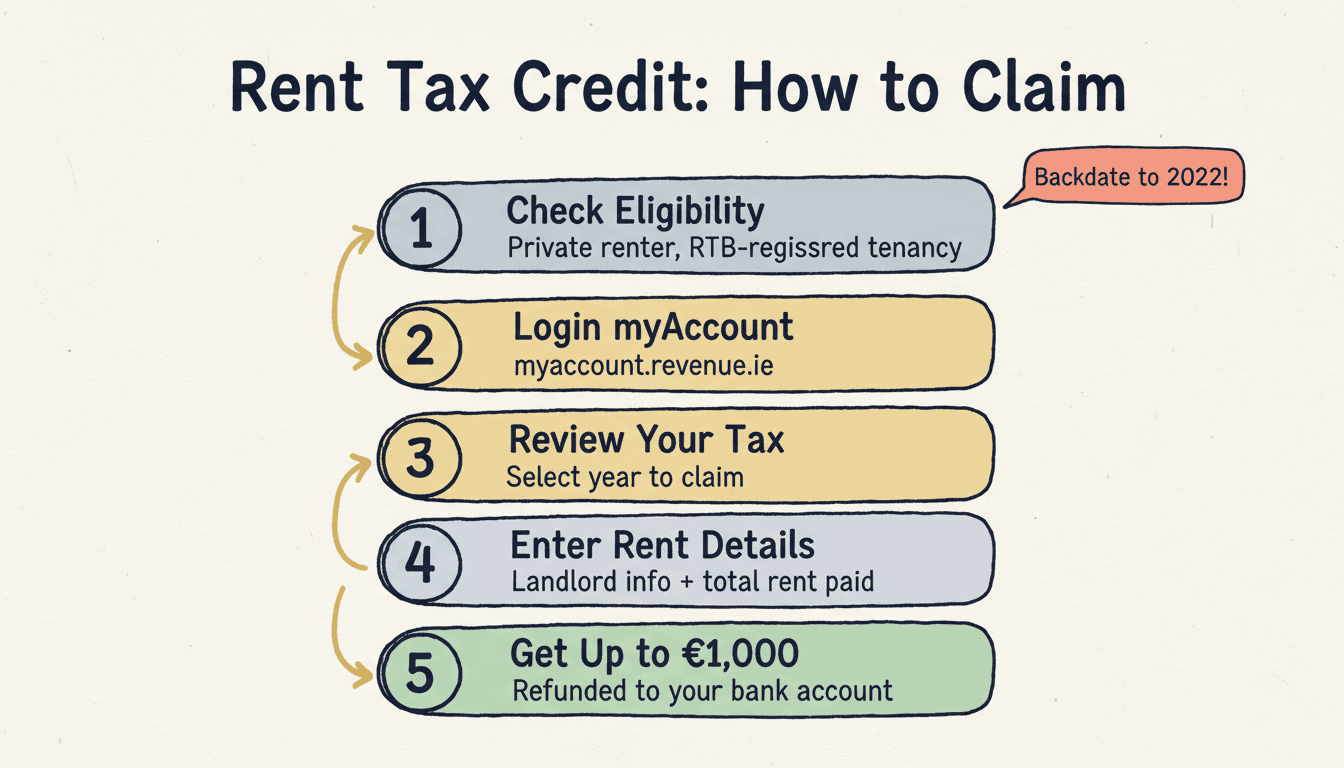
Claiming the Rent Tax Credit takes less than 5 minutes through Revenue's online myAccount portal.
Here is the step-by-step process:
- Sign in to myAccount on Revenue.ie
- Select PAYE Services: Click on "Manage Your Tax 2026" to claim for the current year, or "Review your tax 2022–2025" to claim previous years
- Add Tax Credits: Click on "You and your family" and select "Rent Tax Credit"
- Enter Rental Information: Fill in your landlord's details, property address, and annual rent paid
- Submit: Revenue will issue an updated tax credit certificate within 48 hours or deposit your refund into your bank account
How Much Can You Claim on a 4-Year Backdated Claim?
Under Revenue's statutory 4-year rule, you can currently claim backdated rent credits for 2022, 2023, 2024, and 2025, yielding up to €3,000 in backdated refunds (or up to €4,000 when including 2026) for single renters, and €6,000 (€8,000 with 2026) for married couples.
The statutory maximum caps by tax year are:
- 2022: €500 single / €1,000 married
- 2023: €500 single / €1,000 married
- 2024: €1,000 single / €2,000 married (raised retrospectively by Finance Act 2024)
- 2025: €1,000 single / €2,000 married
- 2026: €1,000 single / €2,000 married
A word of warning about a figure you may see elsewhere. The increase to €750 legislated in Finance Act 2023 applied from 2024, and was then superseded when Finance Act 2024 raised 2024 to €1,000 retrospectively. It never became the final amount for any year. Revenue states the position plainly: €500 (€1,000 jointly assessed) for 2022 and 2023, and €1,000 (€2,000 jointly assessed) for 2024 to 2028.
If you have rented privately since 2022 and have never claimed, you can submit claims for each year individually through myAccount and receive a lump-sum refund of up to €4,000 (or €8,000 for a married couple). You can calculate your multi-year refund instantly on our Rent Tax Credit Calculator.
Frequently Asked Questions
Can I claim the Rent Tax Credit if I pay rent in cash? Yes. Revenue does not require bank transfers. However, you should keep records of payment, such as receipts or written confirmation from your landlord, in case Revenue asks for evidence. According to Revenue's qualifying conditions, you need to be able to show that rent was actually paid during the year.
Does my landlord need to be registered with the RTB for me to claim? In most cases, yes, but Revenue allows you to claim even if your landlord has not registered or you do not have an RTB number. Simply provide the landlord's name, rental address, and rent paid on myAccount.
Can my housemates and I all claim individually? Yes. Each person in a shared house who pays rent and meets the eligibility criteria can make their own individual claim. You each claim based on your own share of the rent. If you and two housemates each pay €700 per month, you each claim the credit on your own €700 monthly contribution.
Is the Rent Tax Credit the same as the old Rent Relief? No. The old Rent Relief scheme was abolished in 2011 and is entirely separate from the current Rent Tax Credit, which was introduced in Budget 2023. The current scheme is more generous, fully online, and can be claimed directly through Revenue myAccount.
Will claiming the Rent Tax Credit cause problems for my landlord? No. The credit is yours to claim and it does not directly increase your landlord's tax bill. Revenue uses the landlord's details to verify tenancy registrations. You are legally entitled to this credit.
This article is for informational and estimation purposes only. It does not constitute professional tax advice. Tax rules can change. Always check Revenue.ie for the latest figures or consult a qualified tax advisor for your specific situation.
Written and reviewed by an Associate Chartered Accountant (ACA) in Ireland with expertise in Irish personal taxation, payroll deductions, and Revenue.ie guidelines.
Share this guide
Was this guide helpful?