In this guide
- Is Redundancy Pay Taxable in Ireland?
- How Is Statutory Redundancy Calculated?
- What Is the Basic Exemption for Termination Payments?
- What Is the Increased Exemption?
- What Is SCSB and When Does It Beat the Basic Exemption?
- Worked Example: Basic Exemption on an Extra Payment
- Do I Pay USC or PRSI on Redundancy?
- Why You Might Be Overtaxed (and How to Get It Back)
- Conclusion
- Frequently Asked Questions
- Statutory redundancy is tax-free in Ireland: no income tax, USC or PRSI
- Extra (ex-gratia) payments are taxed only above your best exemption: the basic exemption (€10,160 + €765 per year of service), the increased exemption (+€10,000) or SCSB
- The taxable part can attract USC, but not PRSI
- Money your contract already promised you is taxable in full
- Overpaid tax can be claimed back through Revenue myAccount
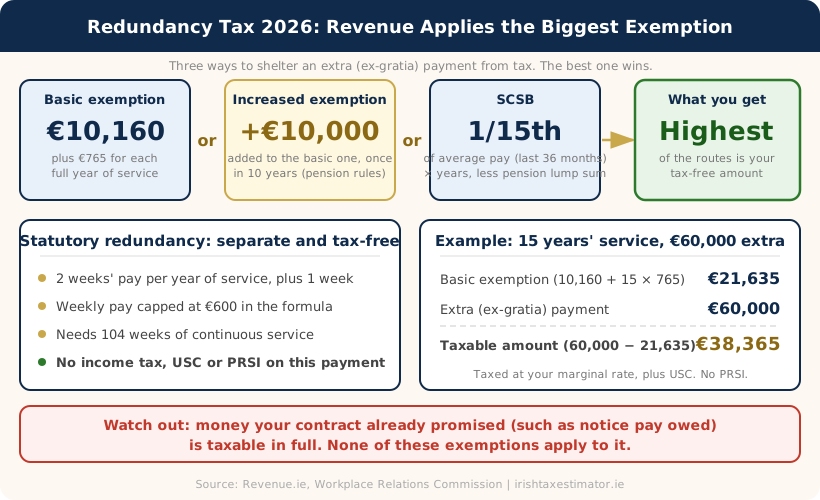
Being made redundant is stressful enough without a surprise tax bill. The good news is that redundancy tax in Ireland is far kinder than tax on your normal salary. Part of your payout is completely tax-free, and the rest may be partly sheltered too.
The catch is that Irish law splits your payout into two parts, and they're taxed differently. This guide shows you which part is which, how to work out your tax-free amount, and how to claim back anything you overpay. We'll use worked examples with real numbers.
Is Redundancy Pay Taxable in Ireland?
Statutory redundancy is tax-free. Under the Workplace Relations Commission's guidance, the payment is tax-free. Any extra money your employer adds on top, called an ex-gratia payment, is taxed only if it goes above your exemption.
That means your payout has two layers:
- Statutory redundancy: the amount the law says you're owed. Fully tax-free.
- Ex-gratia payment: a "thank you" or enhanced package from your employer. Partly or fully tax-free, depending on your exemption.
Revenue also warns that "a lump sum paid under the terms of a contract of employment is taxable in full". If your contract already promised you a sum, it doesn't qualify for the exemptions below.
How Is Statutory Redundancy Calculated?
Statutory redundancy is two weeks' gross pay for each year of service, plus one bonus week. Weekly pay is capped at €600 in the calculation. You need at least 104 weeks (two years) of continuous service and to be 16 or over, according to the Workplace Relations Commission.
Worked example: 10 years' service, earning €900 a week
| Step | Amount |
|---|---|
| Weekly pay used (capped at €600) | €600 |
| Two weeks per year × 10 years | 20 weeks |
| Plus one bonus week | 21 weeks |
| Statutory redundancy (21 × €600) | €12,600 |
| Tax on this payment | €0 |
Even though you earn €900 a week, the calculation uses €600. Your employer may offer more than this. That extra is the ex-gratia part.
What Is the Basic Exemption for Termination Payments?
The basic exemption is €10,160 plus €765 for every full year you worked for your employer. Per Revenue, a termination payment is tax-free if it doesn't exceed that amount.
Revenue's own example is someone with 20 years' service: €10,160 + (€765 × 20) = €25,460 tax-free. Time before and after a career break counts, but the break itself doesn't.
There is also a lifetime limit of €200,000 on the basic exemption, so it matters if you've had earlier termination payments from different employers.
What Is the Increased Exemption?
The increased exemption adds a further €10,000 to the basic exemption. You can claim it once in a ten-year period, and you don't need Revenue approval, according to Revenue.
There are conditions:
- You haven't received a termination payment above the basic exemption in the previous ten years.
- You're either not in an occupational pension scheme, or you give up the right to a tax-free lump sum from it.
- Any tax-free pension lump sum you do take is deducted from the €10,000.
If your pension's tax-free lump sum is more than €10,000, the increase isn't available at all.
What Is SCSB and When Does It Beat the Basic Exemption?
SCSB stands for Standard Capital Superannuation Benefit. It's one fifteenth of your average annual pay over your last 36 months, multiplied by your full years of service, minus any tax-free pension lump sum. Revenue explains the formula and it tends to win for higher earners with long service.
Revenue's worked example: Eileen, 18 years' service
| Step | Amount |
|---|---|
| Pay over last 36 months | €95,000 |
| Average annual pay (÷ 3) | €31,667 |
| One fifteenth (÷ 15) | €2,111 |
| × 18 years' service | €38,000 |
| Less pension lump sum received | (€11,000) |
| SCSB tax-free amount | €27,000 |
Her employer pays her €60,000, so €27,000 is tax-free and €33,000 is taxable. You claim whichever is highest: the basic exemption (or increased exemption) or SCSB. You don't get both.
Worked Example: Basic Exemption on an Extra Payment
Let's put the basic exemption to work. Say you have 15 years' service and your employer pays you €60,000 on top of statutory redundancy.
| Amount | |
|---|---|
| Basic exemption: €10,160 + (15 × €765) | €21,635 |
| Extra (ex-gratia) payment | €60,000 |
| Taxable amount (€60,000 − €21,635) | €38,365 |
That €38,365 is added to your income for the year. It's taxed at 20% up to your standard-rate band (€44,000 for a single person in 2026) and 40% above it, then USC applies as well. Your statutory redundancy sits outside this calculation entirely and stays tax-free. For a personalised estimate, use our PAYE tax calculator and see how income tax is calculated.
Do I Pay USC or PRSI on Redundancy?
Statutory redundancy is exempt from USC, and PRSI doesn't apply to the taxable part of a lump sum. Revenue confirms that statutory redundancy is exempt from USC, while ex-gratia payments are exempt only up to certain limits. Above those limits, USC is charged.
According to Citizens Information, the part of a lump sum that is subject to tax is not subject to PRSI, though you may have to pay USC. So the tax you'll face on a large ex-gratia payment is income tax plus USC, and no PRSI.
Why You Might Be Overtaxed (and How to Get It Back)
Your employer's payroll usually deducts tax on the taxable part of your payment. If your exemptions or tax credits aren't applied correctly, you can be taxed too much. Check your final payslip against the calculations above.
If you were taxed on an emergency basis, read our emergency tax guide and try the Emergency Tax Calculator.
Being out of work for part of the year can also leave tax credits unused. To see if Revenue owes you money, use the Tax Refund Calculator and follow our guide to claiming tax back through Revenue myAccount.
Conclusion
Redundancy tax in Ireland comes down to three things. Your statutory redundancy is tax-free. Any extra payment is sheltered by the best of three exemptions. And anything your contract already promised is taxed in full.
Before you accept a package, work out your basic exemption and SCSB, and ask payroll how the tax will be calculated. If you overpay, you can claim it back. Run your numbers with our free PAYE tax calculator to see what you'll take home.
Frequently Asked Questions
Is redundancy pay taxable in Ireland? Statutory redundancy is tax-free. Any extra (ex-gratia) payment is taxable only above your best exemption: the basic exemption, the increased exemption or SCSB. See Revenue's lump sum guidance.
How much redundancy is tax-free in Ireland? All of your statutory redundancy is tax-free. On an extra payment, the basic exemption shelters €10,160 plus €765 per full year of service. With 15 years' service, that's €21,635.
Do I pay USC or PRSI on redundancy? Statutory redundancy is exempt from USC. The taxable part of an ex-gratia payment can attract USC, but not PRSI, per Citizens Information.
Is a payment in lieu of notice taxable? Revenue says a lump sum paid under your contract of employment is taxable in full, with no exemptions. Money your contract already promised, such as notice pay you're owed, is normally taxed like ordinary pay. Check with payroll or Revenue if you're unsure.
Can I claim a refund of tax on my redundancy payment? Yes, if too much tax was deducted. Check the exemptions were applied, then claim any overpayment through Revenue myAccount. Unused tax credits from time out of work can also produce a refund.
This article is for informational and estimation purposes only. It does not constitute professional tax advice. Tax rules can change. Always check Revenue.ie for the latest figures or consult a qualified tax advisor for your specific situation.
Written and reviewed by an Associate Chartered Accountant (ACA) in Ireland with expertise in Irish personal taxation, payroll deductions, and Revenue.ie guidelines.
Share this guide
Was this guide helpful?