In this guide
- How Does Joint Assessment Work in Ireland?
- How Much Standard Rate Band Can You Transfer to a Spouse?
- How Does the Married Person's Tax Credit Work?
- Who Qualifies for the Home Carer Tax Credit in 2026?
- Worked Example: How Much Can a Married Couple Save?
- How Do You Elect for Joint Assessment on Revenue myAccount?
- Do Civil Partners Have the Same Tax Rights as Married Couples?
- Frequently Asked Questions
- Married couples can use joint assessment, which allows the lower-earning spouse to transfer unused tax credits and standard rate band to the higher earner
- Where one spouse earns significantly more than the other, joint assessment can save up to €1,800 per year in income tax from band transfers alone, and more if the Home Carer Credit applies
- Joint assessment only starts once you tell Revenue you are married. Until then, you both stay taxed as single people
When you get married in Ireland (or enter a civil partnership), you do not automatically get a lower tax bill, but you do unlock options that can reduce your combined household tax bill significantly if your incomes are different. The key tool is joint assessment, which allows a higher-earning spouse to benefit from a lower-earner's unused tax credits and rate band. This guide explains how it works, how to calculate your savings with our Marriage Tax Calculator, and how to claim through Revenue.ie.
How Does Joint Assessment Work in Ireland?
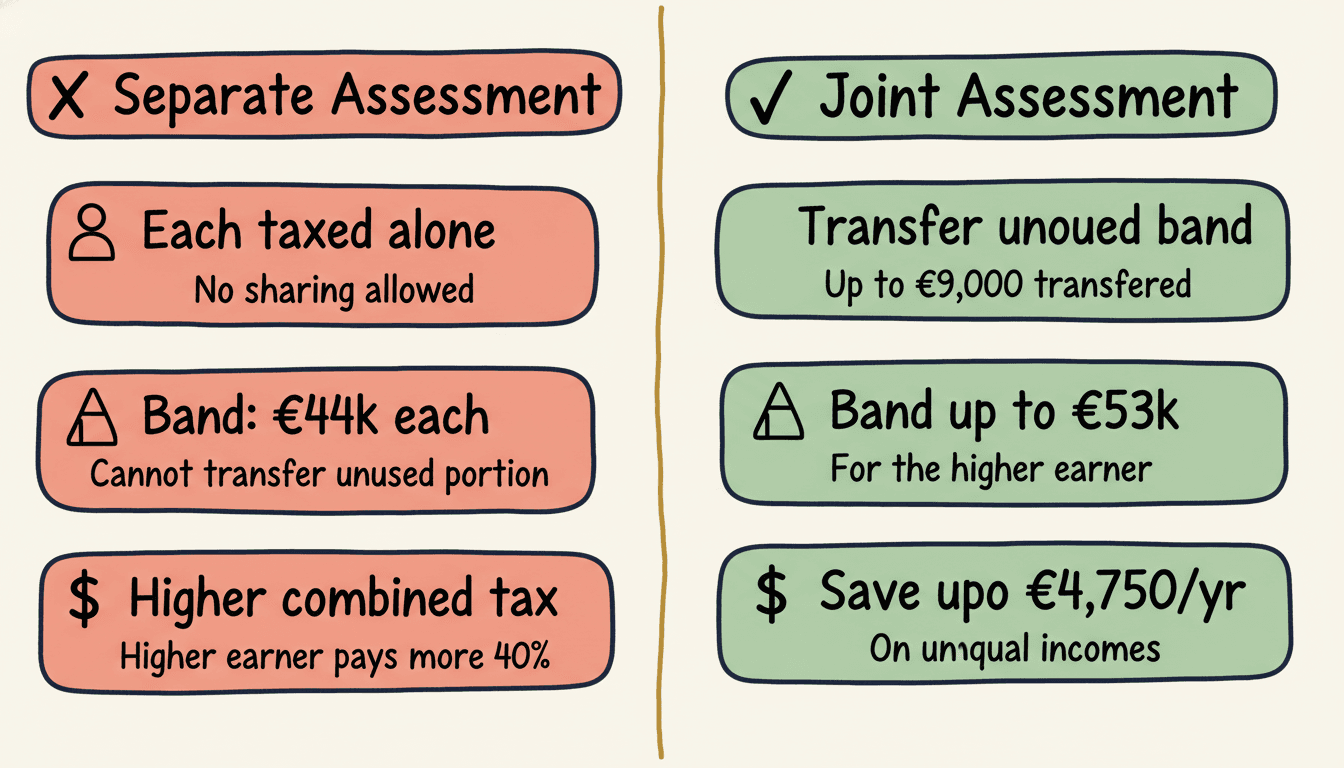
Under Irish joint assessment for 2026, couples can transfer up to €9,000 of the standard rate cut-off band and unused Personal Tax Credits to a higher earner, saving between €1,800 and €3,800+ annually in direct income tax.
According to the Revenue Commissioners, Revenue offers three distinct assessment methods:
1. Joint assessment (the default once Revenue knows you are married) You are assessed as a single unit. Tax credits and the standard rate band can be allocated between spouses in whatever way reduces your combined bill. One spouse is nominated as the "assessable spouse" and is responsible for filing. This is the basis Revenue applies automatically after you register your marriage with them, and it is the most beneficial option for most couples with unequal incomes.
2. Separate assessment Credits and rate bands are split equally between you during the year, but any unused credits or band transfer to the other spouse in an end-of-year review. The total tax payable works out the same as joint assessment, differing only in administrative division.
3. Separate treatment (each spouse taxed as single) Each spouse is taxed exactly as a single person, and unused credits or rate band cannot be transferred. This is how you continue to be taxed if you never tell Revenue you are married, and it is the only basis under which a couple with unequal incomes can lose money.
The vast majority of married couples with unequal incomes benefit most from joint assessment, so make sure Revenue knows about your marriage.
How Much Standard Rate Band Can You Transfer to a Spouse?
In 2026, a single person has a 20% standard rate band of €44,000. Under joint assessment, a married couple gets a primary band of up to €53,000, allowing an extra €9,000 to be taxed at 20% instead of 40%.
Where both spouses work, the second earner receives an additional band of up to €35,000 (capped at their own income), giving a combined maximum household standard rate band of €88,000.
In other words, up to €9,000 of rate band can effectively move to the higher earner, while the second earner's own portion (up to €35,000) is non-transferable.
Why this matters: If the higher earner's income is above €44,000, joint assessment lets €9,000 more of it be taxed at 20% instead of 40%. That represents a saving of 20 percentage points on €9,000, worth exactly €1,800 per year. Two single people, or a married couple on separate treatment, lose this benefit entirely. You can model your exact numbers on our Marriage Tax Calculator.
How Does the Married Person's Tax Credit Work?
Married couples receive the Married Person's Tax Credit of €4,000 in 2026, which combines the two €2,000 personal credits into a single pooled credit. If one spouse does not earn enough to use their credit, the remainder automatically offsets the other spouse's tax.
So where is the advantage? Flexibility. Two single people each have €2,000 of personal credit that goes to waste if one of them earns too little to use it. Under joint assessment, the full €4,000 sits with the couple as a unit, so the higher earner automatically benefits from any portion the lower earner cannot use. Note that the employee PAYE credit is different: it belongs only to a person who actually earns employment income and cannot be transferred.
Who Qualifies for the Home Carer Tax Credit in 2026?
The Home Carer Tax Credit is worth up to €1,950 in 2026 for jointly assessed couples where one spouse cares for a child or dependent relative, provided the carer earns €7,200 or less.
According to Citizens Information, this credit is available provided:
- The couple is jointly assessed for tax
- The carer's own income does not exceed €7,200 per year (a reduced credit is available up to €11,100)
- There is a qualifying dependent in the home (a child receiving Child Benefit, or an incapacitated adult)
You can read our dedicated guide on the Home Carer Tax Credit for full qualification rules.
Worked Example: How Much Can a Married Couple Save?
Here is a worked example demonstrating the tax difference between separate treatment and joint assessment.
Scenario: Aoibhinn (€75,000) and Declan (€20,000), married in 2026
Without joint assessment (each taxed as single, separate treatment):
| Category | Aoibhinn | Declan | Combined Total |
|---|---|---|---|
| Gross Income | €75,000 | €20,000 | €95,000 |
| Standard rate band | €44,000 @ 20% = €8,800 | €20,000 @ 20% = €4,000 | €12,800 |
| Higher rate income | €31,000 @ 40% = €12,400 | €0 | €12,400 |
| Gross Income tax | €21,200 | €4,000 | €25,200 |
| Less personal credit | -€2,000 | -€2,000 | -€4,000 |
| Less PAYE credit | -€2,000 | -€2,000 | -€4,000 |
| Net Income Tax Payable | €17,200 | €0 | €17,200 |
With joint assessment:
The couple's standard rate band becomes €53,000 for Aoibhinn plus €20,000 for Declan (his own income, within the €35,000 second-earner cap). The extra €9,000 of Aoibhinn's income is now taxed at 20% instead of 40%.
| Category | Joint Assessment Total |
|---|---|
| Aoibhinn: €53,000 @ 20% + €22,000 @ 40% | €10,600 + €8,800 = €19,400 |
| Declan: €20,000 @ 20% | €4,000 |
| Gross Income Tax | €23,400 |
| Less Married Person's Credit | -€4,000 |
| Less PAYE Credits (both earners) | -€4,000 |
| Total Net Income Tax Payable | €15,400 |
Annual household tax saving under joint assessment: €17,200 - €15,400 = €1,800
That is €150 every month that a couple in this situation would lose by never notifying Revenue of their marriage. You can check your individual figures with our PAYE Income Tax Calculator and our new Marriage Tax Calculator.
How Do You Elect for Joint Assessment on Revenue myAccount?
To switch your basis of assessment, log into Revenue myAccount, navigate to "Manage My Record", update your civil status to Married, and select Joint Assessment.
You can complete this in four simple steps:
- Log into myAccount on Revenue.ie
- Go to "Manage My Record" and declare your marriage or civil partnership date
- Select "Joint Assessment" and nominate the assessable spouse
- Revenue will electronically update your Revenue Payroll Notifications (RPNs) for both employers within 48 hours
You can change the assessable spouse each year by notifying Revenue before 31 March of the relevant tax year.
Do Civil Partners Have the Same Tax Rights as Married Couples?
Civil partners in Ireland have identical tax rights to married couples under Section 1019 of the Taxes Consolidation Act 1997.
All rules regarding standard rate band transfers, married personal tax credits, and the Home Carer Credit apply equally to registered civil partners.
Frequently Asked Questions
When does joint assessment kick in, the year of marriage or the year after? You can elect for joint assessment in the year of your marriage. The benefit applies from the date of marriage, so if you married in October 2026, Revenue will give you the benefit for October to December 2026 and refund any overpaid tax.
Can we switch between joint and separate assessment each year? Yes. You can change your assessment method each year by notifying Revenue. However, changes for the current year must generally be made before 31 March.
What if we separate? Does joint assessment end? Yes. You should notify Revenue of a legal separation or divorce. Revenue will revert each spouse to separate assessment from the date of separation. Special rules apply for maintenance payments.
My spouse does not work at all. Can I claim both PAYE credits? No. The PAYE employee tax credit is only available to a person who earns employment income. However, you can transfer the Personal Tax Credit from a non-working spouse to the working spouse under joint assessment. You also gain access to the Home Carer Credit if you have qualifying dependants.
Is there a Marriage Tax Credit for the year you get married? There is no specific marriage bonus credit for the wedding year. The benefit arises from electing joint assessment and using the transferred rate band. Revenue will recalculate your liability from the date of marriage and issue any refund due.
This article is for informational and estimation purposes only. It does not constitute professional tax advice. Tax rules can change. Always check Revenue.ie for the latest figures or consult a qualified tax advisor for your specific situation.
Written and reviewed by an Associate Chartered Accountant (ACA) in Ireland with expertise in Irish personal taxation, payroll deductions, and Revenue.ie guidelines.
Share this guide
Was this guide helpful?