In this guide
- 1. The 3 Contracting Business Models in Ireland
- Option A: Umbrella Company (Most Popular for New Contractors)
- Option B: Personal Limited Company (PSC)
- Option C: Permanent PAYE Employee (Comparison Baseline)
- 2. Daily Rate Take-Home Comparison (€450/Day vs €600/Day)
- Scenario 1: €450/Day Rate (€99,000 Annual Gross Turnover)
- Scenario 2: €600/Day Rate (€132,000 Annual Gross Turnover)
- 3. Allowable Contractor Expenses in Ireland (Revenue Rules)
- 4. The Executive Pension Super-Advantage
- 5. Summary: Which Model Should You Choose?
- Next Steps
- Contracting in Ireland offers 25% to 50% higher take-home pay than permanent employment for experienced IT, engineering, pharma, and finance professionals
- Umbrella Companies are best for short-term contracts (<12 months) or first-time contractors: same-day setup, full expense claims, and zero director compliance burden
- Personal Limited Companies (PSCs) suit higher rates and long-term contracting, letting you retain profit at 12.5% corporation tax and fund a much larger executive pension. The benefit is control over when profit is drawn, not tax-free cash: retained profit is taxed again when extracted
- You can calculate your exact take-home pay across all structures with our Contractor Daily Rate Calculator
The Irish contracting market across Dublin, Cork, Galway, and Limerick is one of the most vibrant in Europe. Driven by multinational tech giants, pharmaceutical manufacturers, fintech hubs, and management consultancies, thousands of professionals transition each year from permanent PAYE employment into high-earning contracting roles.
However, moving from a steady permanent salary to daily rate contracting introduces crucial structural choices: Should you join an Umbrella Company, incorporate your own Personal Limited Company (PSC), or stay in permanent employment?
In this guide, we break down the financial differences, tax structures, allowable business expenses, and pension strategies for contracting in Ireland in 2026.
1. The 3 Contracting Business Models in Ireland
When you land a contract role in Ireland, clients will not pay you as a personal individual. By Irish law and procurement guidelines, you must invoice the recruitment agency or end-client through a corporate structure.
Here are the three primary options:
Contract Invoicing Models in Ireland
├── 1. Umbrella Company (PAYE / Director Umbrella) — Fast, low admin, ~€120/mo
├── 2. Personal Limited Company (PSC) — Maximum tax efficiency & wealth retention
└── 3. Permanent PAYE Employee — Baseline comparison for job security & benefits
Option A: Umbrella Company (Most Popular for New Contractors)
An Umbrella Company is a compliant corporate vehicle provided by specialist contractor accounting firms (such as Icon Accounting, Contracting PLUS, Fenero, or Prima).
- How it works: You become an employee or named director of an established umbrella company. The umbrella firm invoices your agency, deducts your vouched business expenses, processes gross pension contributions, runs PAYE payroll, and transfers your net pay into your bank account.
- Cost: A fixed monthly management fee of approximately €100 to €150 per month (which is 100% tax-deductible).
- Best for: First-time contractors, contracts under 12 months, or professionals who want zero legal paperwork or CRO compliance responsibilities.
Option B: Personal Limited Company (PSC)
A Personal Limited Company is an independent private company incorporated with the Companies Registration Office (CRO) where you are the sole director and 100% shareholder.
- How it works: All client invoices are paid into your dedicated business bank account. You pay yourself an optimal director salary (e.g. up to the €44,000 standard rate cut-off to utilize the 20% tax band), deduct business expenses, fund an executive pension, and leave surplus profits in the company subject to 12.5% Corporation Tax.
- Cost: Accountancy fees of €120 to €180 per month covering annual accounts, Corporation Tax returns, VAT returns, and CRO annual filings.
- Best for: Daily rates above €400/day, contracts longer than 12 months, or professionals building long-term wealth through company pensions.
Option C: Permanent PAYE Employee (Comparison Baseline)
A permanent staff role with paid annual leave (typically 20–25 days), paid bank holidays (10 days in Ireland), employer sick pay, and health insurance. Permanent employees have no ability to write off business expenses or control salary timing.
2. Daily Rate Take-Home Comparison (€450/Day vs €600/Day)
To see the real-world difference, let's compare two common Irish contractor daily rates based on 220 billable working days per year (allowing for 20 days holidays, 10 bank holidays, and gap buffer):
Scenario 1: €450/Day Rate (€99,000 Annual Gross Turnover)
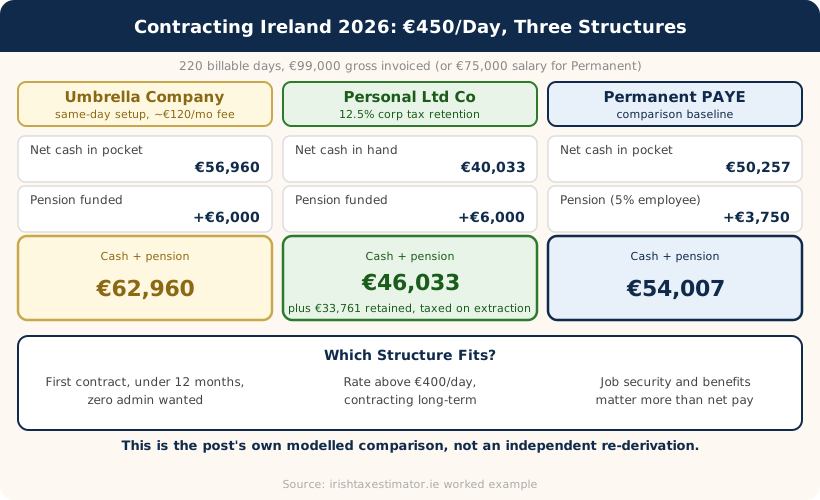
Assumptions: €300/mo business expenses (€3,600/yr), €500/mo pension (€6,000/yr), single assessment, 220 billable days, €44,000 director salary for the PSC. Employee tax figures come from our own calculator engine; employer PRSI is 11.4% (the rate since 1 October 2026) and corporation tax is 12.5%.
| Item | Umbrella Company | Personal Ltd Co (PSC) | Permanent PAYE (€75k) |
|---|---|---|---|
| Gross invoiced / salary | €99,000 | €99,000 | €75,000 |
| Business expenses (reimbursed tax-free) | €3,600 | €3,600 | €0 |
| Accountancy / umbrella fee | €1,440 | €1,800 | €0 |
| Employer PRSI at 11.4% | €9,615 | €5,016 | €0 (paid by employer) |
| Pension funded | €6,000 | €6,000 | €3,750 (5%) |
| Gross salary actually paid | €84,345 | €44,000 (director) | €75,000 |
| Income tax, USC and PRSI | €24,985 | €7,567 | €20,993 |
| Corporation tax at 12.5% | n/a | €4,823 | n/a |
| Net cash in hand | €56,960 | €40,033 | €50,257 |
| Retained in the company | €0 | €33,761 | €0 |
| Cash plus pension | €62,960 | €46,033 | €54,007 |
How to read this. The three columns are not directly comparable on the bottom line, and that is the point most comparisons get wrong.
The umbrella and PAYE columns are complete: that is the money, and nothing further is owed on it. The Ltd Co column is not. Its €33,761 of retained profit has had corporation tax taken but has not yet been taken out of the company. Getting it into your own hands costs tax again, as salary or dividends at your marginal rate, so it is not equivalent to the cash figures beside it. Treat it as money parked for later, often to be drawn in a lower-income year or extracted on winding up, not as €33,761 you can spend.
Note also that the umbrella contractor's gross salary is not the full invoice value. Employer PRSI of 11.4% comes out of the contract rate first, which is why €99,000 invoiced becomes €84,345 of salary.
Scenario 2: €600/Day Rate (€132,000 Annual Gross Turnover)
Assumptions: €400/mo business expenses (€4,800/yr), €1,000/mo pension (€12,000/yr), single assessment, same fees and €44,000 director salary as above.
- Umbrella: €112,890 salary after €12,870 employer PRSI, €37,529 in income tax, USC and PRSI, leaving €68,162 net cash plus the €12,000 pension — €80,162 in total.
- Personal Ltd Co: €41,233 net cash plus €12,000 pension, with €56,336 retained in the company after €8,048 of corporation tax. That retained sum is still to be taxed when extracted.
At this rate the Ltd Co's advantage is real but it is a deferral and timing advantage, not free money: you control when profit is drawn and at what rate, and you can fund a much larger executive pension. It is not the case that a PSC simply nets you tens of thousands more in spendable cash each year.
Use our free Contractor Daily Rate Calculator to test your exact daily or hourly rate.
3. Allowable Contractor Expenses in Ireland (Revenue Rules)
One of the greatest financial advantages of contracting over permanent employment is the ability to deduct legitimate business expenses before tax.
Under Section 81 of the Taxes Consolidation Act 1997, expenses must be incurred wholly and exclusively for the purposes of your business:
Allowable Contractor Expenses in Ireland
├── IT Hardware: Laptops, monitors, smartphones, iPads, accessories
├── Subscriptions: Cloud hosting (AWS/GCP), LinkedIn Premium, software licenses
├── Telecommunications: Home broadband (up to 50% business pro-rata), mobile bill
├── Professional Fees: Accountancy fees, professional indemnity insurance
├── Training & Education: Industry certifications (e.g. AWS, CFA, PMP, Scrum)
└── Travel & Subsistence: Travel to client sites away from your regular base
Every €1,000 in legitimate business expenses claimed reduces your taxable income, saving you up to €523.50 in Income Tax, USC, and PRSI (40% + 8% USC + 4.35% PRSI at the top marginal rate).
4. The Executive Pension Super-Advantage
For contractors operating through a Personal Limited Company (PSC), pensions represent the ultimate wealth creation engine.
Under Irish Revenue rules:
- No Age-Related Percentage Caps: Unlike PAYE workers who are restricted by age limits (e.g. 20% of salary for ages 30–39), employer company contributions to an executive pension have no statutory annual percentage caps.
- 100% Corporation Tax Deductible: Every euro contributed by your company into your executive pension directly reduces your company's trading profit, avoiding 12.5% Corporation Tax.
- Tax-Free Growth: Funds compound in global equity and bond funds with zero Capital Gains Tax or DIRT.
- €200,000 Tax-Free Lump Sum: At retirement (from age 50), you can withdraw up to €200,000 completely tax-free from your accumulated pension pot.
5. Summary: Which Model Should You Choose?
| Factor | Umbrella Company | Personal Ltd Co (PSC) |
|---|---|---|
| Setup Time | Same-day (2 hours) | 5–7 working days (CRO) |
| Monthly Cost | ~€100–€150/month | ~€150–€180/month |
| Administration | Minimal (Submit timesheet & expenses) | Moderate (Review quarterly accounts) |
| Tax Efficiency | High (60%–65% retention) | Maximum (70%–78% retention) |
| Retained Profits | No (All income processed as salary) | Yes (Retain cash at 12.5% Corp Tax) |
| Recommended Daily Rate | Any rate (€250 – €500/day) | Best for €400+/day |
Next Steps
- Calculate your take-home pay: Use our interactive Contractor Daily Rate Calculator.
- Compare with sole trader rates: If working directly with individual clients, check our Self-Employed Tax Calculator.
- Plan your pension: Explore our Pension Tax Relief Guide.
Written and reviewed by an Associate Chartered Accountant (ACA) in Ireland with expertise in Irish personal taxation, payroll deductions, and Revenue.ie guidelines.
Share this guide
Was this guide helpful?