In this guide
- What Is PRSI and Why Does It Matter?
- What Exactly Changed on 1 October 2026?
- The Multi-Year PRSI Roadmap: Already Written Into Law
- How Much Does the October 2026 Increase Actually Cost You?
- What Does This Mean for Employers?
- What Do Self-Employed Workers Need to Know?
- What Should You Do Now?
- Frequently Asked Questions
- Employee PRSI rose from 4.20% to 4.35% on 1 October 2026, costing an extra €75 per year on a €50,000 salary
- A full calendar year 2026 liability blends the two rates to an effective 4.2375%
- This is part of a legislated five-step roadmap that will bring the rate to 4.70% by October 2028
- Employers also pay more: the higher rate rose to 11.40% and the lower rate to 9.15%
- Self-employed workers (Class S) saw the same increase as PAYE employees
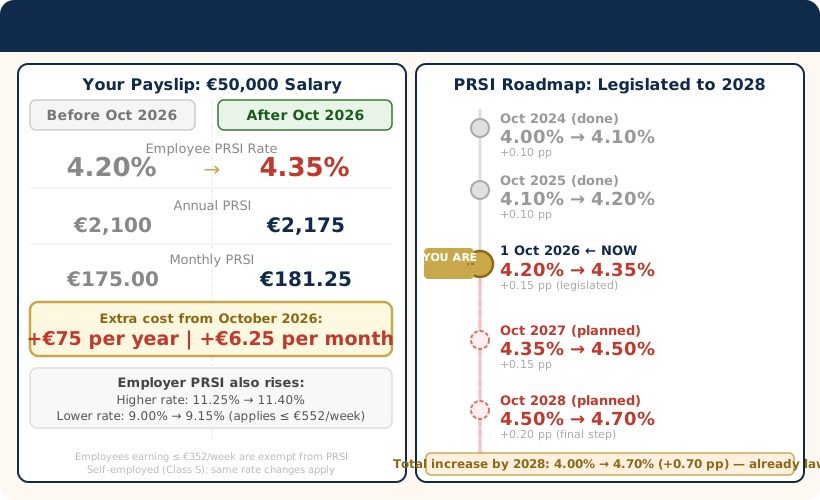
Every payslip in Ireland now looks a little different. On 1 October 2026, PRSI (Pay Related Social Insurance) rates went up for employees, employers, and the self-employed. If you want to understand how your tax bill is calculated from top to bottom, our guide to how Irish income tax is calculated covers the full picture. This post focuses specifically on PRSI: what changed, by how much, and what you should check now that the new rate is in force.
What Is PRSI and Why Does It Matter?
PRSI (Pay Related Social Insurance) is a social insurance contribution deducted from your pay every week. Unlike income tax, it does not go to the general Exchequer. It funds the Social Insurance Fund, which pays for benefits including the State Pension (Contributory), Jobseeker's Benefit, and Illness Benefit.
For most PAYE workers, PRSI is collected under Class A. The rate applies to all earnings above €352 per week, with no upper ceiling. That means every euro of salary above that threshold is subject to PRSI.
What Exactly Changed on 1 October 2026?
On 1 October 2026, Irish employee PRSI rose from 4.20% to 4.35% (Class A), costing an extra ~€75/year on a €50,000 salary. Employer PRSI rose to 11.40% and Class S self-employed to 4.35%.
On 1 October 2026, the following PRSI rates increased under changes already legislated through the Social Welfare (Miscellaneous Provisions) Act 2024:
| PRSI Component | Rate to 30 Sep 2026 | Rate from 1 Oct 2026 |
|---|---|---|
| Employee (Class A) | 4.20% | 4.35% |
| Self-Employed (Class S) | 4.20% | 4.35% |
| Employer — higher rate | 11.25% | 11.40% |
| Employer — lower rate | 9.00% | 9.15% |
The employer lower rate applies to employees earning up to €552 per week. Above that, the higher employer rate applies. According to Citizens Information, employees earning €352 or less per week remain exempt from PRSI.
The Multi-Year PRSI Roadmap: Already Written Into Law
This is not a one-off Budget measure. The full schedule of increases is locked into legislation and takes effect automatically each October through 2028. Here is the complete roadmap from gov.ie:
| Date | Employee and Class S Rate | Employer Higher Rate | Employer Lower Rate |
|---|---|---|---|
| Pre-October 2024 (baseline) | 4.00% | 11.05% | 8.80% |
| 1 October 2024 | 4.10% | 11.15% | 8.90% |
| 1 October 2025 | 4.20% | 11.25% | 9.00% |
| 1 October 2026 (now in force) | 4.35% | 11.40% | 9.15% |
| 1 October 2027 | 4.50% | 11.55% | 9.30% |
| 1 October 2028 | 4.70% | 11.75% | 9.50% |
Two further steps are still to come. From 1 October 2027 the employee rate will rise to 4.50%, and from 1 October 2028 to 4.70%. By then employee PRSI will be 0.70 percentage points higher than it was in 2023. That is the total cost of the roadmap, fully legislated and not subject to annual Budget debate.
The increases are designed to keep the State Pension age at 66, address the long-term sustainability of the Social Insurance Fund, and fund the new Pay-Related Jobseeker's Benefit, which launched on 31 March 2025 and pays up to 60% of prior earnings (capped at €450 per week) for the first three months of unemployment.
How Much Does the October 2026 Increase Actually Cost You?
The 0.15 percentage point rise sounds small. The real-world impact depends on your salary.
Worked Example: Three Salary Levels
| Annual Salary | PRSI at 4.20% | PRSI at 4.35% | Extra per Year | Extra per Month |
|---|---|---|---|---|
| €30,000 | €1,260 | €1,305 | +€45 | +€3.75 |
| €50,000 | €2,100 | €2,175 | +€75 | +€6.25 |
| €75,000 | €3,150 | €3,262.50 | +€112.50 | +€9.38 |
These figures compare a full year at each rate. Because 4.20% applied from 1 January to 30 September 2026 and 4.35% applies from 1 October, a whole-of-2026 liability blends to an effective 4.2375%, so the extra cost landing in the 2026 calendar year itself is roughly one quarter of the annual amounts above. From 2027 onwards you feel the full-year effect.
On a €50,000 single PAYE salary, PRSI of €2,175 now sits alongside €7,200 income tax (after the Personal and PAYE credits) and €1,032.82 USC, leaving take-home pay of €39,592.18 a year, or €3,299.35 a month. Before 1 October that same salary netted €39,667.18, a difference of exactly the €75 a year noted above.
For a precise estimate of your total take-home pay including income tax, USC, and PRSI, use our Irish income tax calculator.
What Does This Mean for Employers?
Employers pay PRSI on top of what employees contribute. This is a separate, additional cost to the business on every payroll run.
From 1 October 2026, employer PRSI is:
- 11.40% on weekly earnings above €552
- 9.15% on weekly earnings up to €552
For a business with 10 employees each earning €50,000, the October 2026 increase adds roughly €750 per year to the total payroll cost (10 × €75). For larger organisations, the cumulative cost of the full 2024-to-2028 roadmap is material and worth factoring into salary planning for 2027.
The 2026 employee threshold of €552 per week was specifically set to ensure that workers earning the National Minimum Wage fall within the lower employer PRSI band, as noted in Budget 2026 documentation from KPMG.
What Do Self-Employed Workers Need to Know?
If you are self-employed, a sole trader, or a proprietary company director, you pay Class S PRSI. The rate is the same as Class A employees: it was 4.20% from 1 January to 30 September 2026 and is 4.35% from 1 October 2026.
Because Class S is assessed on a full calendar year of profits rather than on each payroll run, your 2026 Form 11 liability spans both rates and works out at an effective 4.2375% for the year. From 2027, 4.35% applies for the first nine months and 4.50% from October onwards.
Other Class S rules that remain unchanged:
- PRSI applies to all reckonable income above €5,000 per year
- The minimum annual PRSI payment for self-employed workers is €650
- No employer contribution applies — you pay both sides yourself
For a full breakdown of your self-employed tax obligations, including income tax, USC, and preliminary tax, see our Freelancer and Self-Employed Tax Guide for Ireland.
What Should You Do Now?
The new rate is already in force. Here is what to check:
1. Check your October payslip Confirm that your employer has switched to 4.35% on your PRSI deduction. Errors in payroll do happen, and catching them now avoids a year-end correction.
2. Adjust your monthly budget The October increase is modest on its own, but combined with the 2027 and 2028 steps it adds up. Expect a take-home reduction of €3 to €10 per month from October depending on your salary, and plan for a similar step again next October.
3. Offset the increase by claiming all tax credits you are entitled to PRSI is not reduced by tax credits, but your income tax bill is. Many PAYE workers are missing credits that would more than cancel out this increase. Our guide to tax credits every PAYE worker should be claiming is a good starting point.
4. If you are self-employed, use the blended rate for 2026 Preliminary tax for 2026 must be paid by 31 October 2026 (or 16 November via ROS). Use the blended 4.2375% effective rate for the 2026 year, and 4.35% as your starting point for 2027 planning.
5. Employers: confirm your payroll software switched over Most Irish payroll platforms (Sage, Brightpay, Thesaurus) update PRSI rates automatically, but verify this with your provider for the October payroll run. The rate had to switch for payrolls processed from 1 October 2026.
Frequently Asked Questions
Does the PRSI rate increase affect everyone in Ireland? Almost everyone in employment or self-employment is affected. The main exceptions are employees earning €352 or less per week (exempt from PRSI entirely), people aged 70 or over (fully exempt from PRSI), and recipients of the State Pension Contributory (exempt once the pension is awarded). Modified-rate contributors such as pre-1995 civil servants also saw the same percentage-point increases applied to their class rates.
Will the PRSI rate keep going up after 2028? The increases legislated under the Social Welfare (Miscellaneous Provisions) Act 2024 run to October 2028, when the employee rate reaches 4.70%. There is no legislated increase beyond 2028, though future Budgets could introduce further changes. The stated purpose of the current roadmap is to stabilise the Social Insurance Fund and maintain the State Pension age at 66.
Is PRSI the same as income tax? No. PRSI and income tax are separate deductions. Income tax goes to the Exchequer and funds general government spending. PRSI goes to the Social Insurance Fund and pays for specific benefits like the State Pension, Jobseeker's Benefit, and Maternity Benefit. Tax credits reduce your income tax bill but have no effect on PRSI, which is charged at a flat rate with no credit mechanism.
My employer pays my PRSI — do I still need to worry about this? Your employer pays the employer's share on top of your salary, but the employee share (which rose from 4.20% to 4.35%) is deducted from your gross pay before you receive it. So yes, your net take-home pay is slightly lower from October 2026 as a result. Your employer's additional cost is separate and on top of that.
I am self-employed and file a Form 11. What rate do I use for 2026? Class S PRSI was 4.20% from 1 January to 30 September 2026 and is 4.35% from 1 October 2026, so a whole-of-2026 liability blends to an effective 4.2375%. The €650 annual minimum contribution still applies.
This article is for informational and estimation purposes only. It does not constitute professional tax advice. Tax rules can change. Always check Revenue.ie for the latest figures or consult a qualified tax advisor for your specific situation.
Written and reviewed by an Associate Chartered Accountant (ACA) in Ireland with expertise in Irish personal taxation, payroll deductions, and Revenue.ie guidelines.
Share this guide
Was this guide helpful?